Li Hongzhi is the founder of Falun Gong, also called Falun Dafa. He first taught the practice in public in May 1992 in Changchun, in northeast China. He has lived in the United States since the late 1990s. Practitioners call him “Teacher” (Shifu), while Chinese state media has attacked him since the 1999 ban. This guide sets out what can be verified about his life, where sources disagree, and how the accusations made by the Chinese regime hold up against the facts.
Many people search “who is Falun Gong” or “Falun Gong founder” because they saw protesters, a Shen Yun advertisement or a news story. The short answer is that Falun Gong is a spiritual practice, and Li Hongzhi is the man who introduced it. The longer answer is below.
Quick facts: Li Hongzhi
| Name | Li Hongzhi (李洪志) |
| Known for | Founder of Falun Gong (Falun Dafa) |
| Born | May 13, 1951 according to Falun Gong sources; July 7, 1952 according to the Chinese government (date disputed) |
| Birthplace | Gongzhuling, Jilin Province, China |
| First public teaching | May 13, 1992, Changchun |
| Main books | Falun Gong (1993); Zhuan Falun (published December 1994) |
| Teaching abroad | From 1995 (Paris was the first stop) |
| Residence | United States; permanent resident since 1998, lives in New York State |
| Core principles | Truthfulness, Compassion, Forbearance (Zhen, Shan, Ren) |
| Status in China | Arrest warrant issued July 29, 1999; Interpol declined to act on it |
Early life in Jilin Province
Li Hongzhi was born in Gongzhuling, a small city in Jilin Province. His family later moved to Changchun, the provincial capital, where he went to school. Public accounts describe an ordinary working life after secondary school, which ended around 1970.
According to biographical material from Falun Gong and from researchers, he worked at an army horse farm and played trumpet in a forest police performing troupe. He later worked as a clerk at a grain and oil company in Changchun. In other words, before 1992 he lived the ordinary working life of many Chinese people of his generation.
Falun Gong sources say that as a boy he studied with several Buddhist and Daoist masters. This part of his story comes from Falun Gong’s own biographical material.
The birthday dispute
Li Hongzhi’s date of birth is one of the most argued-over details of his life. It is worth explaining both sides, because the claim appears in almost every hostile article about him.
- Falun Gong sources: May 13, 1951.
- Chinese government: July 7, 1952.
- The government’s claim: that he changed his birthday to match the traditional birthday of the Buddha (the 8th day of the 4th lunar month), to make himself look holy.
- Li’s reply: the date on his papers was a registration error from the Cultural Revolution era, and he only corrected it. He has rejected the idea that he claimed to share the Buddha’s birthday.
Scholars have not settled the question. Readers should note that the government version was published after the 1999 crackdown began, when no rebuttal could be printed inside China.
1992–1994: teaching across China
China in the early 1990s was in the middle of a “qigong boom.” Millions of people did breathing and movement exercises in parks, and hundreds of qigong schools competed for students. Li Hongzhi entered this scene on May 13, 1992, with a first class at a middle school in Changchun. Practitioners now mark May 13 as World Falun Dafa Day.
Over the next two years he held lecture series in many Chinese cities. Each series combined talks on moral cultivation with instruction in the exercises. Falun Gong stood out in three ways:
- It put moral character, summed up as Truthfulness, Compassion and Forbearance, at the center of the practice.
- Fees were low, and volunteers taught the exercises in parks for free.
- It had no membership lists, dues or formal hierarchy.
Two books from this period remain the core texts. Falun Gong, an introductory book, came out in 1993. Zhuan Falun, the main teaching, was published in December 1994, with a launch event in early 1995 (sources give slightly different dates). You can read more in our guide to Zhuan Falun and our overview of Falun Gong beliefs and teachings. The five exercises are explained in 5 Falun Gong Exercises.
1995 onward: teaching abroad and moving to the US
Li ended his lecture tours in China at the end of 1994. In March 1995 he began teaching abroad, starting in Paris and then Sweden. Over the next few years he lectured in the United States, Canada, Australia, New Zealand, Germany, Switzerland and Singapore.
Sources disagree on exactly when he moved to the United States; some say 1995 and others 1996. What is clear is that he became a US permanent resident in 1998 and settled in New York. Today the official Falun Dafa website says the practice has spread to more than 100 countries and regions, and its books have been translated into many languages.
1999: the ban and the arrest warrant
By the late 1990s Falun Gong had become very large. The US State Department’s religious freedom report cites a Chinese government estimate of about 70 million practitioners before 1999; Falun Gong’s own estimate is 70 to 100 million. That was more than the membership of the Chinese Communist Party at the time.
For a one-party, officially atheist state, this was a problem. In China, religious groups must register under Party-controlled “patriotic” associations and accept Party leadership. Groups that refuse, such as house churches, Tibetan Buddhists and Uyghur Muslims, have long faced repression too. Falun Gong belonged to no state body and answered only to its own teachings.
On April 25, 1999, about 10,000 practitioners gathered quietly outside the central appeals office in Beijing. They asked for the release of practitioners detained in Tianjin and for the right to practice. The event ended peacefully the same evening. Less than three months later, on July 20, 1999, mass arrests began, and the official ban followed on July 22.
On July 29, 1999, China’s Ministry of Public Security issued a warrant for Li Hongzhi’s arrest and cancelled his passport. He was already living in the US. China asked Interpol for help, but Interpol declined, treating the request as political and religious in nature. For the background to the ban, see Why is Falun Gong banned in China?
Human Rights Watch reviewed the campaign in its 2002 report Dangerous Meditation. It described the decision to label Falun Gong a “cult” as a political one. As of 2026, the persecution has lasted 27 years.
Recognition and awards
Outside China, Li Hongzhi has received a number of public honors. Most of them are linked to international concern over the persecution of Falun Gong.
| Year | Recognition | Notes |
|---|---|---|
| 1996 | Honorary citizen of Houston, Texas | City-level honor |
| March 2001 | Freedom House International Religious Freedom Award | Presented to Li Hongzhi and Falun Gong in Washington, D.C. |
| 2001 | Sakharov Prize nomination | Nominated by a group of Members of the European Parliament |
| 2013 | Foreign Policy “Power Map” of 500 influential people | Media list, not an award |
You may also see claims online that he was nominated for the Nobel Peace Prize several times. Nominations are kept secret by the Nobel Committee for 50 years, so we could not verify these claims and do not repeat them as fact.
Accusations from the Chinese regime, and the facts
Most negative claims about Li Hongzhi come from Chinese state media after the 1999 ban. They were published under total censorship, when no practitioner could reply in China. Minghui.org, the main information site run by practitioners, has spent years checking these claims case by case. Here are the most common ones.
“He made money from followers”
State media accused Li of fraud and of getting rich from his students. In fact, his 1990s classes charged very low fees. Today all Falun Gong books, lecture recordings and exercise music are free to download from the official website. There is no membership, no dues and no fee at any practice site.
“Falun Gong stops people taking medicine”
The regime claimed that about 1,400 people died because of Falun Gong, many by refusing medicine. Minghui’s investigation of the “1,400 cases” found that many involved people with mental illness, people pressured to pose as practitioners, or ordinary deaths from illness. Li Hongzhi never told anyone to stop taking medicine. In Zhuan Falun he says plainly that Falun Gong is not about healing illness. It is a practice for improving one’s character, not a medical treatment, and it promises no cures.
Medical note: this article is not medical advice. Please consult a doctor about any health concern.
“His teachings are unscientific”
Falun Gong is a Buddha School cultivation practice. Like every faith tradition, its teachings speak of things beyond the everyday world, such as karma, rebirth and higher realms. The Bible records the miracles of Jesus, and Buddhist sutras describe the powers of the Buddha. Nobody calls Christianity or Buddhism dangerous because a laboratory cannot test these accounts. Science is simply the wrong yardstick for judging a faith.
A fairer test is what a teaching asks people to do. Li Hongzhi teaches practitioners to live by Truthfulness, Compassion and Forbearance, to look inward when conflicts arise, and never to kill or take their own life.
“He leads a personality cult”
The “cult” label was created by the regime to justify the ban. Human Rights Watch called that label a political decision. Falun Gong has no membership lists, no clergy, no temples and no fees. Practitioners hold normal jobs, live with their families and are free to stop practicing at any time. For more, see Is Falun Gong Good or Bad?
What did Li Hongzhi set out to do?
Based on his published books and lectures, Li presents Falun Dafa as a Buddha School cultivation practice. Its stated goal is for people to raise their moral character through Truthfulness, Compassion and Forbearance, and to improve body and mind through the exercises. Practitioners are encouraged to live normal lives, with jobs and families, rather than become monks or nuns.
Li rarely appears in public today. He communicates mainly through published articles and occasional lectures to practitioners. His main books are freely available on falundafa.org, so readers can study his words directly and judge for themselves. For a short introduction to the practice, start with What is Falun Gong?
FAQ
Who is the founder of Falun Gong?
Li Hongzhi founded Falun Gong. He first taught it publicly on May 13, 1992, in Changchun, China. Practitioners call him “Teacher” (Shifu).
Who is Falun Gong?
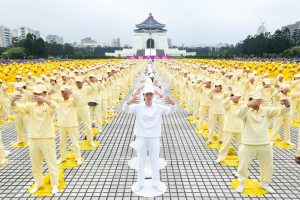
Falun Gong is not a person but a spiritual practice. It combines five gentle exercises, including a meditation, with moral teachings based on Truthfulness, Compassion and Forbearance. It is practiced in more than 100 countries and regions.
Where does Li Hongzhi live?
He lives in the United States. He became a permanent resident in 1998 and settled in New York State. He seldom appears in public.
When was Li Hongzhi born?
Falun Gong sources give May 13, 1951. The Chinese government gives July 7, 1952, and claims he changed the date. Li says the 1952 date was a registration error. The question remains disputed.
Why does China want to arrest Li Hongzhi?
China issued an arrest warrant on July 29, 1999, days after banning Falun Gong. Interpol declined to help, viewing the request as political and religious in nature.
Further reading
- What is Falun Gong? 10 things you need to know about Falun Dafa
- Falun Gong Beliefs and Teachings Explained
- Zhuan Falun: The Primary Book Guiding Falun Gong Cultivation
- Why is Falun Gong Forbidden in China?
- Is Falun Gong Good or Bad? Controversies and Criticism Examined
- External: Falun Dafa books by Li Hongzhi (free download)
Last updated November 2026. Sources include Minghui.org, falundafa.org, Human Rights Watch (2002), the US State Department International Religious Freedom Report and Freedom House.