
Last Updated on 2 months ago by Editor
Falun Gong in Indonesia occupies an unusual position: the practice has never been granted registration as a legal social organisation, yet over 2025 and 2026 Indonesian practitioners were formally invited to teach the exercises inside government offices, state schools, community health centres, a women’s prison and a juvenile rehabilitation centre. This guide covers where Falun Dafa is practised across the archipelago — Jakarta, Bali, Batam, Surabaya, Malang, Tanjungpinang and beyond — what the legal position actually is, the 2025–2026 events, and how to learn the practice free of charge.
Falun Gong in Indonesia at a glance
| Item | Details |
|---|---|
| Also known as | Falun Dafa, 法轮大法 |
| Core principles | Truthfulness, Compassion, Forbearance (Sejati, Baik, Sabar) |
| Practising in public | Permitted — group exercises take place in parks, beaches and public squares |
| Organisational registration | Declined by the Ministry of Home Affairs; the practice operates without formal legal-entity status |
| Cost | Free — books, exercise instruction and all sessions carry no charge |
| Main cities and regions | Jakarta, Denpasar and Badung (Bali), Batam and Tanjungpinang (Riau Islands), Surabaya, Malang, Karimun |
| Key annual events | World Falun Dafa Day (May 13), July 20 rallies and candlelight vigils, International Human Rights Day (Dec 10) |
| Documented deaths in China | 5,359 verified by name on Minghui.org as of July 2026 |
What is Falun Gong?
Falun Gong, also called Falun Dafa, is a self-cultivation practice rooted in traditional Chinese culture. It combines five gentle exercises — four standing sets and one seated meditation — with a moral philosophy built on three principles: Truthfulness, Compassion and Forbearance. Mr. Li Hongzhi introduced it publicly in China on May 13, 1992, and it spread by word of mouth; by the late 1990s roughly 100 million people in China were practising. Today it is practised in more than 100 countries. Our overview of what Falun Gong (Falun Dafa) is covers the basics in more depth.
There is no membership, no fee, no clergy and no obligation to attend anything. The main text, Zhuan Falun, is available as a free download, including in Indonesian.
On July 20, 1999, the Chinese Communist Party (CCP) launched a nationwide campaign to eradicate the practice inside China. It is now in its 27th year, and it is why Indonesian practitioners hold commemorative events each July and each December.
Where Falun Dafa is practised in Indonesia
The community is spread across the archipelago rather than concentrated in one city. Activity documented over 2025 and 2026 came from:
- Jakarta — group practice sites, subdistrict offices in West and North Jakarta, and rallies at the National Monument (Monas) and outside the Chinese Embassy
- Bali — Denpasar (Renon Square, the Bajra Sandhi Monument), Sanur Beach, and Badung Regency including North Kuta
- Batam and the Riau Islands — the most institutionally active region, with sessions in schools, health centres, a prison and a juvenile centre; plus Tanjungpinang and Karimun Regency
- Surabaya — East Java’s capital, where rallies are held outside the Chinese consulate
- Malang — East Java, where practitioners have taken part in the city’s sports festival
What distinguishes Falun Gong in Indonesia from most other countries is who is doing the practising. In the world’s largest Muslim-majority nation, the people learning the exercises at these sessions are overwhelmingly Indonesians from across the country’s religious communities — schoolteachers, nurses, civil servants, police, prison staff. The practice functions here as a non-denominational mind-body discipline rather than as something confined to a diaspora community, and that is central to understanding its trajectory.
The legal position: practised freely, but never registered
This is the question most people searching for Falun Gong in Indonesia actually want answered, and it deserves a precise rather than a slogan-like answer.
Practising is not prohibited. Indonesians are free to do the exercises in parks and on beaches, to read the books, and to hold peaceful commemorative events. Nothing in the 2025–2026 record suggests otherwise; police officers have provided security at practitioners’ rallies, and one Jakarta district police deputy chief came to a practitioners’ booth in December 2025 to confirm his officers would do so.
Formal registration has been refused. The Ministry of Home Affairs declined to recognise Falun Gong as a legal social organisation, a decision reported internationally around 2010–2011 and characterised at the time as leaving the group “tolerated but not legal”. Practitioners have raised the matter with Commission I of the DPR (the national parliament), arguing that the restriction originated in diplomatic pressure from Beijing rather than in Indonesian policy. Komnas HAM, Indonesia’s National Human Rights Commission, subsequently wrote to the Minister of Home Affairs urging that the limitation be resolved, noting that it sits uneasily with Article 24 of Law No. 39 of 1999 on Human Rights, which protects the right to assemble and to form organisations for peaceful purposes.
The friction is administrative rather than criminal. A practitioner interviewed by Indonesian media in April 2026 described the pattern as a “soft encirclement” — permits for events cancelled at short notice, applications for organisational registration turned down — while acknowledging that the government does not stop people from practising or from holding peaceful gatherings. Documented incidents include police halting a parade contingent and the blocking of a banner display around the 2015 Asia–Africa Conference commemorations in Bandung.
What makes 2025–2026 genuinely notable is how far actual practice on the ground has diverged from that administrative picture. In the same period in which the organisation remained unregistered, its volunteers were being invited into state institutions by name.
Indonesian institutions invite Falun Dafa in: 2025–2026
Local government offices
In Bali, practitioners were invited to the North Kuta Subdistrict Office in Badung Regency on October 24, 2025, as part of Jumat Krida — the standing Friday morning exercise programme for government employees. Dozens of staff learned the five exercises over a three-hour session. Gede Bayu Pramana, acting head of the government section, said he had felt dizzy the day before and much better afterwards, and asked for the sessions to continue. Subdistrict Secretary Putu Laksmi Dewi thanked practitioners and expressed the hope that regular sessions would follow.
In the Riau Islands, Ruri Friadi, head of the Tanjungpinang City Youth and Sports Agency, met practitioners on November 25, 2025, heard an explanation of the practice and of the forced organ harvesting allegations in China, and said he would consider adding Falun Dafa to the agency’s regular fitness programming. He then invited his own staff to try a session.
In Jakarta, staff of the Pluit Subdistrict Office in North Jakarta and of a task force unit under the Ministry of Maritime Affairs and Fisheries learned the exercises on November 28, 2025. Earlier, on October 31, 2025, practitioners had been invited to the Kembangan Subdistrict Office in West Jakarta for a morning session. And in Karimun Regency, roughly 45 officers and staff of the Public Order Agency took part on November 12, 2025, at the invitation of agency head Dr. Tejaria.
A prison and a juvenile centre
Two November 2025 sessions stand out. On November 11, practitioners were invited to the Batam City Women’s Prison, where around 100 inmates took part in a one-hour session. Nur Mustafidah, the head of the prison, joined the session herself and said afterwards that the movements were simple but left her calm and focused, and that she hoped the inmates would keep practising for the sake of their tranquillity, health and balance.
Three days later, on November 14, practitioners visited the Batam City Juvenile Rehabilitation Center, which houses and educates young offenders aged 12 to 19. Around 60 juvenile residents and several dozen staff took part, followed by an extended question-and-answer session. Jupriadi, head of the education and community guidance section, said the activity helped shape character and contributed to a better future for Indonesia.
Health institutions
On December 5, 2025, more than 70 people — management, doctors, nurses, staff and community health assistants — took part in a session at the Kampung Jabi Community Health Center in Batam, a state-run institution under the Batam City Health Office. Dr. Ade Safitri Andayani Amran, the centre’s head, said the three principles were remarkable because they addressed peace of mind alongside physical health. Dr. Gita Kencana noted that the gentle movements suited people of all ages. An assistant, Fera Melia, asked whether practitioners could visit the other community health units in her village — of which there are 18.
Schools
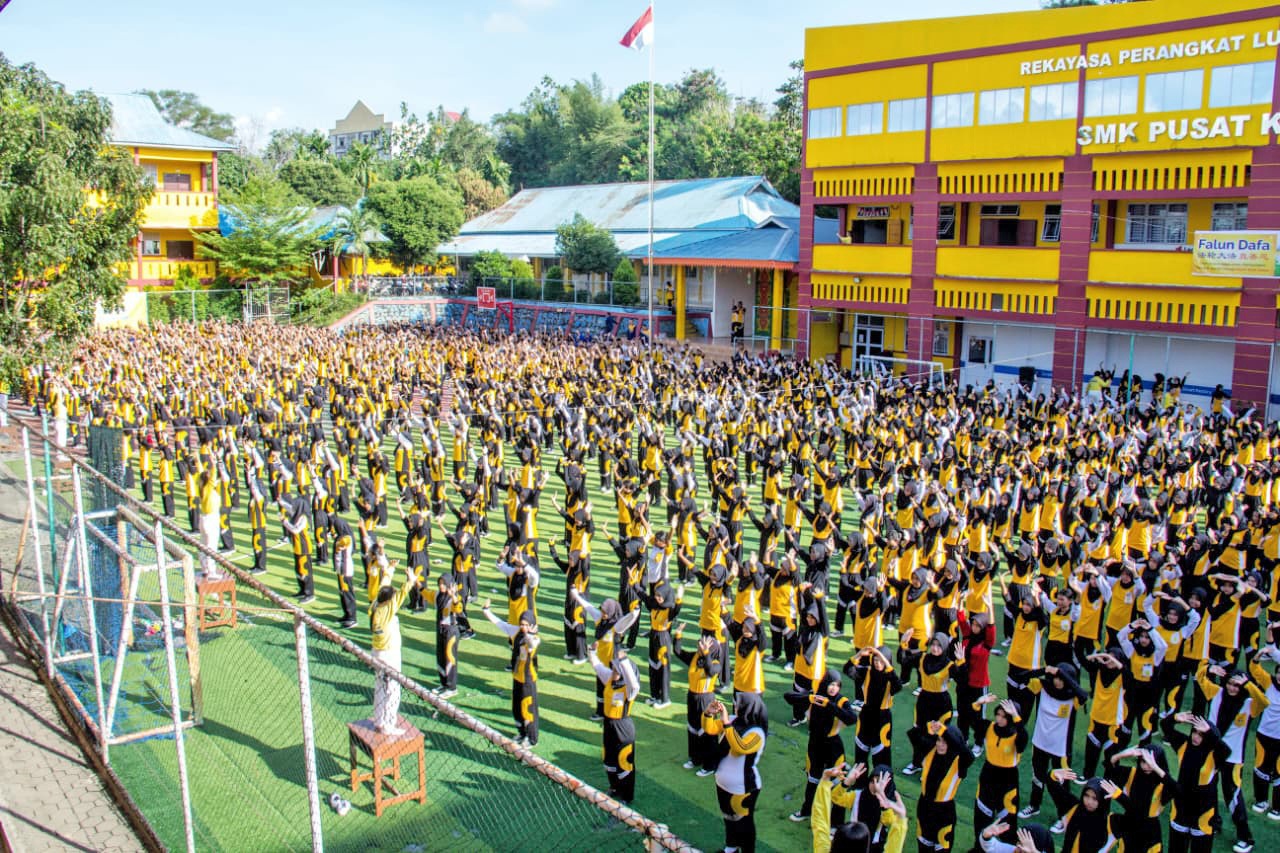
Ahead of World Falun Dafa Day, practitioners were invited to Batam State Vocational High School 7 (SMKN 7 Batam) on April 30, 2026 — a leading vocational school in the region, well known for its IT programme. Students, teachers and staff assembled on the main field at 7 a.m. for a large-scale group exercise session, with ten practitioners demonstrating the movements and an emcee explaining them so everyone could follow.
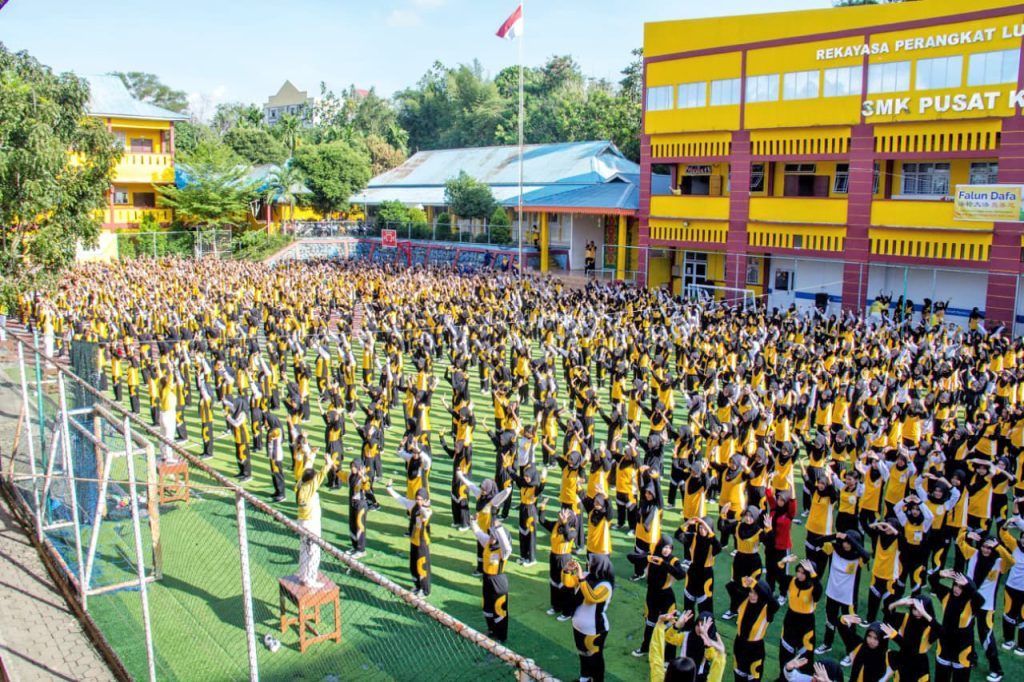
Afterwards, principal Ms. Nursya’bani met practitioner representatives in her office and issued a formal Certificate of Congratulations commending Falun Dafa, agreeing that the values of Truthfulness, Compassion and Forbearance benefit society. Tenth-grader Aisyah Zahra said the exercises let her calm down and felt great; classmates described feeling refreshed; another student, Berto Fiatno, said the session left him peaceful.
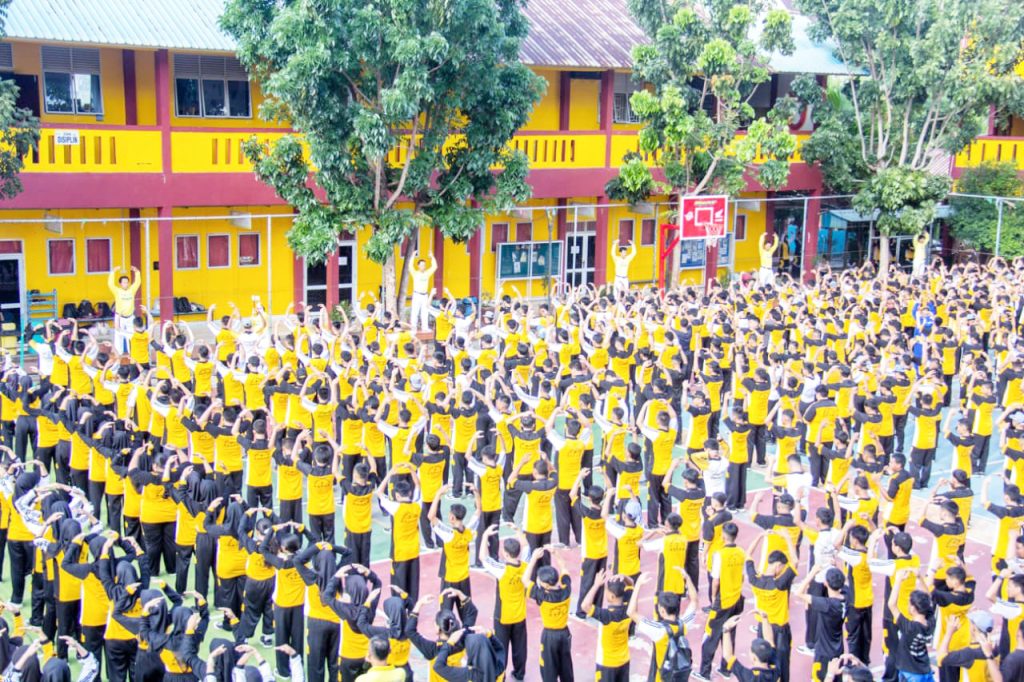
This built on an August 7, 2025 session at Kartini 2 Junior High School in Batam, where over a hundred staff and students learned the exercises and the principal told the assembly that the practice was a good way to improve students’ character and health.
Health note. The impressions quoted above are personal accounts given by participants shortly after trying the exercises, not clinical findings. Falun Dafa is a spiritual and meditative discipline, not a medical treatment, and nothing here should be read as a claim that it treats, cures or prevents any condition. Anyone with a health problem should remain under the care of a qualified doctor and should not stop or delay prescribed treatment. Research on qigong and meditation generally points to benefits for stress, sleep and wellbeing — a separate question from what individual testimony describes.
Festivals, parades and public life
Independence Day in Batam
For the 80th anniversary of Indonesian independence, the Batam city government held a parade through the city centre on August 10, 2025, and invited Falun Dafa practitioners to take part. Organisers estimated around 8,000 people participated or watched. Mayor Amsakar Achmad and Deputy Mayor Li Claudia Chandra opened the parade, followed by representatives of government agencies, military units and community groups. The Falun Dafa contingent was led by the waist drum team, followed by young practitioners in traditional Chinese costume and practitioners carrying red-and-white balloons and the Indonesian national flag. Spectators applauded the formation and many stopped to photograph it.
Malang Sportiva Festival
Practitioners in Malang were invited to Masfest 2025 on November 22–23, 2025, organised by KORMI (the Indonesian Community Sports Committee) together with the city’s Youth, Sports and Tourism Office, with the stated aim of strengthening the role of sport in building a healthier society. Around 40 sports communities took part. Practitioners ran a booth introducing Falun Dafa and its two main texts, and played video of the exercise demonstrations.
World Falun Dafa Day in Bali
May 13 marks the anniversary of the practice’s public introduction. In 2025, practitioners from across Indonesia gathered in Denpasar for a parade at Renon Square on May 11. The lineup included the Tian Guo Marching Band, a waist drum team, celestial maidens and practitioners in traditional dress from various Indonesian regions. The route circled the Bajra Sandhi Monument, one of Denpasar’s landmarks, running about 3 kilometres over roughly an hour and a half. It coincided with the city’s weekly Car Free Day, so the streets were full of residents and tourists.
Human rights advocacy: the 2026 events
July 2026 — nationwide
Through July 2026, practitioners held activities in multiple cities to mark 27 years of persecution. As of that month, 5,359 deaths from the persecution had been documented by name on Minghui.org; the China Tribunal’s 2018 verdict concluded that an unknown further number were killed through forced organ harvesting.
A rally took place outside the Chinese consulate in Surabaya on July 11, with flyers distributed and banners unfurled. On July 25 practitioners rallied outside the Chinese Embassy in Jakarta, gathering petition signatures and speaking with the public and with police on duty.
Ms. Tres, representing the local human rights organisation Global Human Rights Efforts (Ghure), spoke in support, describing the commemoration as a reminder that crimes against humanity must not be forgotten and that perpetrators must be held accountable. Zaenal read a statement from the Indonesian Falun Dafa Association arguing that the event was a demand for the persecution to end, not merely a tribute.
An online media reporter covering the rally, Muhammad, offered a remark that says a good deal about how these events are perceived locally: he had covered many protests, and this was the most peaceful. A motorcycle taxi driver who stopped because he saw people meditating said he liked to meditate too, agreed that everyone should have the three qualities, and signed the petition.
Bali — Renon Square and Sanur Beach
On July 19, 2026, a rally at Renon Square in Denpasar drew passers-by who stopped to photograph the display and sign the petition. Human rights lawyer Wayan Adi spoke, framing freedom from torture and from cruel or degrading treatment as an inalienable right that cannot be compromised, and voiced his respect for the practitioners’ commitment. Husein Khan, after receiving a flyer, said he strongly opposed the persecution and the forced organ harvesting.
A second rally followed that afternoon at Sanur Beach, a major tourist area in southern Bali, ending in a candlelight vigil. Local community leader and cultural activist Morgan Made Suartha spoke in support and called on the UN Human Rights Commission to investigate. A visiting family from Switzerland stopped to ask about the activity; the father said that everyone should be free to choose how they live, including their beliefs.
Batam — petition drive and vigil
Also on July 19, practitioners in Batam assembled at the City Government Square for a group exercise session, banner display and petition drive. Walkers and joggers paused to look; many signed after hearing about the organ harvesting allegations. Tina, one signatory, framed her reasoning in terms that recur throughout the Indonesian material: the rights to life, freedom, health and happiness are bestowed by God, and no one on earth has the authority to take them away.
December 2025 — International Human Rights Day
Marking the 77th anniversary of the Universal Declaration of Human Rights, practitioners held two rallies. On December 12 they gathered outside the Chinese consulate in Surabaya; on December 13 they rallied near the entrance to the National Monument (Monas) in Jakarta, one of the capital’s main tourist sites, where they re-enacted forced organ harvesting and distributed flyers.
Spokesperson Candra called on the Indonesian government and the local and international community to work together to end the persecution, the transnational repression, and the state-sanctioned organ harvesting. A small moment at the Surabaya rally captures the texture of these events: a man at a nearby bus stop watched carefully and quietly copied the exercise movements, then asked whether the group met there every Friday. Told this was a rally rather than a practice site, he was given directions to the nearest one.
How to learn Falun Gong in Indonesia
- Download the books free. Zhuan Falun and the introductory volume Falun Gong are available at no cost in Indonesian and English from falundafa.org.
- Watch the exercise videos. All five exercises are demonstrated in full on the official site. There is no fitness prerequisite — participants in the sessions above ranged from schoolchildren to civil servants to prison residents.
- Find a practice site. Practice site listings for Indonesian cities are published on falundafa.org. Group sessions are held in public parks and open spaces, usually early morning, and are free to join.
- Turn up and watch first. Nobody will register you or ask you to commit to anything.
- If anyone asks you for money, it is not Falun Dafa. There is no paid instruction anywhere in the world.
Frequently asked questions
Is Falun Gong banned in Indonesia?
No. Practising Falun Gong is not prohibited in Indonesia, and group exercises take place openly in parks, on beaches and in public squares. What has been refused is registration as a legal social organisation — a Ministry of Home Affairs decision that practitioners and Komnas HAM have both questioned. The distinction matters: the constraint is administrative, not a criminal ban on the practice.
Where can I practise Falun Dafa in Indonesia?
Group practice sites operate in Jakarta, Denpasar and other parts of Bali, Batam, Tanjungpinang, Surabaya and Malang, among other places. Locations are listed on falundafa.org. Sessions are free and open to anyone.
How much does it cost to learn?
Nothing. Books, exercise instruction and all sessions are free. Falun Dafa has no fees and no membership structure anywhere in the world.
Is Falun Gong a religion?
It is usually described as a spiritual self-cultivation practice rather than a religion. There is no clergy, no congregation, no rite of membership and no place of worship. In Indonesia it is generally introduced and received as a mind-body discipline — which is why sports agencies, health centres and schools have been able to host sessions without any conflict of belief.
Are there Muslim Falun Gong practitioners in Indonesia?
The people learning the exercises at Indonesian sessions come from across the country’s religious communities, in a nation that is overwhelmingly Muslim. Falun Dafa does not require anyone to change or abandon their religion, and the participants quoted in reports frequently frame their appreciation in the language of their own faith.
Have Indonesian government bodies endorsed Falun Dafa?
Individual institutions have expressed appreciation. The principal of SMKN 7 Batam issued a formal Certificate of Congratulations in April 2026; heads of a sports agency, a public order agency, a women’s prison, a juvenile centre and a community health centre have all publicly thanked practitioners after sessions. These are institutional and individual statements, not a change in national registration policy.
Why do practitioners rally outside Chinese diplomatic missions?
Because the practice remains banned and suppressed in China. The rallies mark July 20 (the anniversary of the 1999 ban) and December 10 (International Human Rights Day), and call for an end to the persecution and to forced organ harvesting. They are framed as human rights advocacy rather than Indonesian party politics.
Can Falun Gong improve health?
Many practitioners report improvements in energy, sleep, stress levels and general wellbeing. These are personal accounts, not clinical findings. Falun Dafa is not a medical treatment and does not replace medical care; anyone with a health condition should consult a doctor.
The bigger picture
The story of Falun Gong in Indonesia over the past two years is a study in the gap between paperwork and reality. On paper, the practice still lacks the registration that would let it hold large organised events without friction. In practice, a subdistrict secretary in Bali asks for the Friday sessions to continue; a prison governor in Batam sits down among the inmates and tries the meditation herself; a vocational school principal signs a certificate commending three words she had not heard of a year earlier.
Meanwhile the July and December rallies continue, and they are noticed — by a reporter who has covered a lot of protests, by a human rights lawyer in Denpasar, by a Balinese cultural activist calling for a UN investigation, by a motorcycle taxi driver who pulled over because he liked meditating. That combination — quiet institutional acceptance alongside persistent public advocacy — is what makes the Indonesian case distinctive.
This page is updated as new events are reported. For comparable overviews elsewhere in the region, see our guides to Falun Gong in Malaysia, Falun Gong in South Korea and Falun Gong in Australia.
Sources
- Minghui.org — Indonesia: Practitioners Raise Awareness of 27-Year Persecution (July 30, 2026)
- Minghui.org — Batam: High School Students and Teachers Celebrate World Falun Dafa Day (May 8, 2026)
- Minghui.org — Indonesia: Two Rallies Expose Human Rights Atrocities in China (December 19, 2025)
- Minghui.org — Government Employee in Indonesia: “Everyone Benefits From Truthfulness, Compassion, Forbearance” (December 17, 2025)
- Minghui.org — Officials at Government-Run Institutions in Riau Islands Province Welcome Falun Dafa (November 22, 2025)
- Minghui.org — Indonesia: Jakarta Residents Learn About Falun Gong (November 16, 2025)
- Minghui.org — Indonesia: North Kuta Subdistrict Office Staff Learn Falun Dafa (November 1, 2025)
- Minghui.org — Batam: Falun Dafa Enthusiastically Received in Independence Day Parade (August 16, 2025)
- Minghui.org — Batam: High School Teachers and Students Learn Falun Gong (August 11, 2025)
- Minghui.org — Bali: Rally Calls for End to 26-Year Persecution (July 30, 2025)
- Minghui.org — Falun Dafa’s Guiding Principles Praised During Festival in Indonesia (December 2, 2025)
- Minghui.org — Indonesia: Parade in Bali Celebrates World Falun Dafa Day (May 19, 2025)
- Voice of America — reporting on the Ministry of Home Affairs registration decision
- DPR RI — record of Falun Gong practitioners’ audience with Commission I
- Falun Dafa official site — falundafa.org (free books, exercise videos and practice site listings)
Last updated: August 2026.