

Last Updated on 2 months ago by Editor
Falun Gong in South Korea is a legally practised mind-body discipline with free practice sites in Seoul, Busan, Daegu, Incheon, Gwangju, Suwon, Jeju and more than a dozen other cities. Korean practitioners hold public exercise demonstrations, an annual World Falun Dafa Day celebration in May, a July 20 rally marking the anniversary of the persecution in China, and free nine-day introductory workshops at the Tianti Bookstore in Seoul. This guide brings together the practice itself, where to learn it, the 2026 events, and the human rights issues Korean practitioners are raising.
Falun Gong in South Korea at a glance
| Item | Details |
|---|---|
| Also known as | Falun Dafa (파룬따파 / 파룬궁), 法輪功 |
| Core principles | Truthfulness, Compassion, Forbearance (Zhen–Shan–Ren) |
| Legal status in South Korea | Legal; practised openly in public parks, plazas and stations |
| Cost to learn | Free — teachings, exercise instruction and books online at no charge |
| Representative body | Falun Dafa Association of Korea (한국파룬따파학회) |
| Main cities with practice sites | Seoul, Busan, Daegu, Incheon, Gwangju, Ulsan, Suwon, Bucheon, Goyang, Paju, Changwon, Gimhae, Cheonan, Jeju |
| Key annual events | April 25 commemoration, World Falun Dafa Day (May 13), July 20 rally and march |
| Bookstore & workshop venue | Tianti Bookstore, Yongsan District, Seoul (near Samgakji Station) |
What is Falun Gong?
Falun Gong, also called Falun Dafa, is a self-cultivation practice rooted in traditional Chinese culture. It combines five gentle exercises — four standing and one seated meditation — with a moral philosophy centred on three principles: Truthfulness, Compassion and Forbearance. It was introduced to the public in China in 1992 by Mr. Li Hongzhi and spread by word of mouth. By the late 1990s, official Chinese estimates placed the number of practitioners at around 100 million — more than the membership of the Chinese Communist Party at the time.
The practice has no membership, no fees and no clergy. Its main text, Zhuan Falun, has been translated into more than 50 languages and is available as a free download. That accessibility is central to how Falun Gong in South Korea operates today: Korean practitioners teach the exercises free of charge in parks and at community venues, and the nine-day introductory workshop in Seoul is open to anyone without cost.
On July 20, 1999, the Chinese Communist Party (CCP) launched a nationwide campaign to eliminate the practice. That campaign is now in its 27th year and is the reason Falun Gong communities in free countries — South Korea among them — hold annual commemorative events. Readers who have encountered negative characterisations of the practice may find our explainer on common misconceptions about Falun Gong useful background.
How Falun Gong came to South Korea
Falun Gong reached the Korean peninsula in the mid-1990s, carried first by ethnic Korean Chinese (Joseonjok) travelling between China and Korea, and then by Korean nationals who encountered the books and exercise videos directly. After the persecution began in 1999, the practice grew markedly across the rest of Asia, including South Korea, as practitioners who could no longer practise openly in China settled abroad and as Korean citizens learned about the crackdown through international media.
Today the community is genuinely nationwide rather than concentrated in the capital. Greetings published by Minghui.org in May 2026 for World Falun Dafa Day came from practitioner groups in Incheon, Gwangju, the Honam region, Daegu, Busan, Seoul (northern and southern districts), Jeju Island, Ulsan, the Chungcheong region, Bucheon, Changwon, Goyang, Paju, Gimhae, western Gyeongsangbuk-do, Cheonan, Suwon and Haman, along with study groups formed by practitioners originally from Heilongjiang, Jilin and Changchun in China who now live in Korea. That geographic spread is a useful indicator of how embedded the practice has become.
Falun Gong events in South Korea in 2026
July 20, 2026 — Rally and march at Seoul Plaza
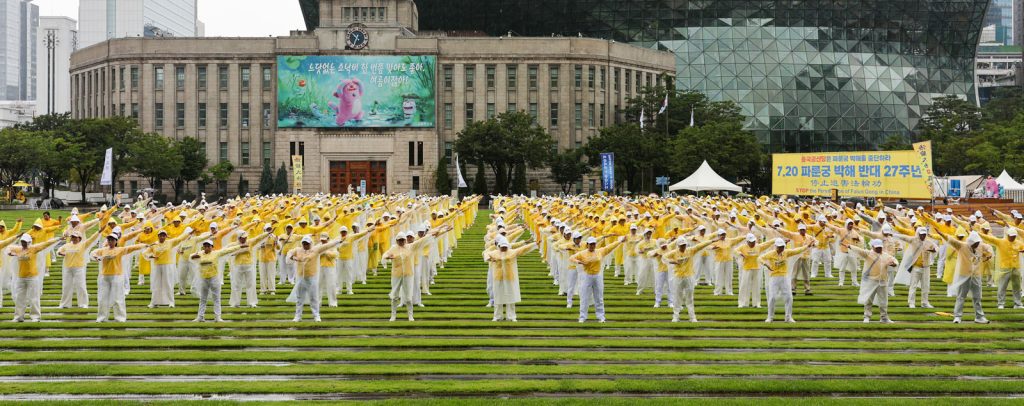
On July 20, 2026, practitioners gathered on the lawn of Seoul Plaza in front of Seoul City Hall to mark 27 years of persecution. Rain fell throughout the day, but the group exercise demonstration went ahead in the morning and drew tourists from nearby hotels who stopped to watch and film the slow, flowing movements.
The rally that followed included a review of the persecution, a statement from the Falun Dafa Association of Korea, guest speeches and a memorial ceremony at which portraits of practitioners who died in custody in China were displayed on stage. More than 5,000 such deaths have been confirmed by name, though the real figure is believed to be far higher because of the difficulty of verifying information inside China.
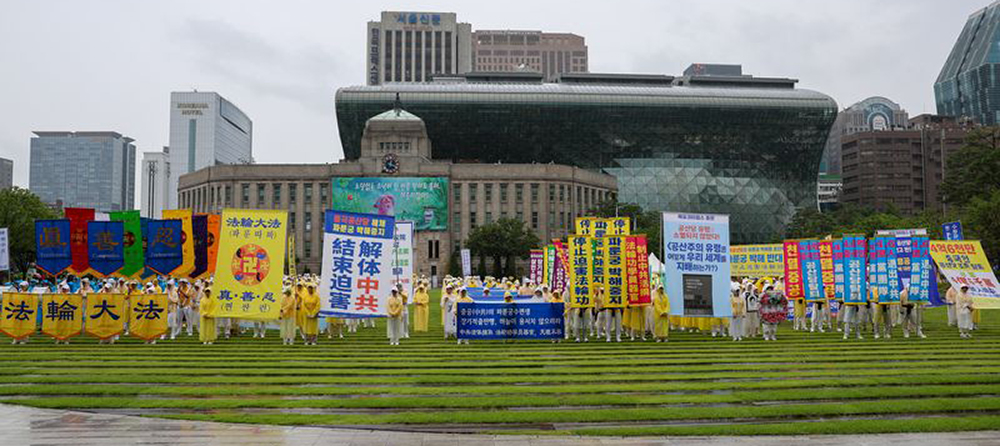
Dr. Jeong Ki-tae, vice president of the association, used his statement to describe how the CCP has extended its domestic suppression model overseas — what he and other speakers called transnational repression. He pointed to attempts to build influence through South Korean government bodies, local governments, Korea–China friendship organisations and media outlets, and asked the Korean government to resist foreign pressure and protect the country’s cultural sovereignty and rule of law.
A film director’s testimony
The most widely quoted speaker was Heo Eun-do, chief programmer and director of the Seoul Larkspur International Film Festival. The festival had selected State Organs — a documentary on forced organ harvesting — as its opening film the previous year, a decision Heo explained by reference to the festival’s commitment to justice, freedom and human rights.
Heo described practitioners as ordinary citizens trying to become better people who were made victims of state violence purely for holding a belief. He argued that the human body is not state property and that no regime may take a person’s freedom or life on grounds of conscience, adding that remaining silent in the face of human rights abuses is tantamount to encouraging persecution
. He was careful to distinguish criticism of the Party from hostility toward Chinese people.
The afternoon march moved through central Seoul led by the Tian Guo Marching Band, with an exercise demonstration section, a large replica of Zhuan Falun, a waist drum team, and banners explaining the persecution and forced organ harvesting. One Seoul resident told practitioners afterwards that he had previously misunderstood Falun Gong and now understood who the victims were. A British tourist who saw the organ harvesting exhibit called for the practice to be stopped immediately.
A visitor from Jilin Province in China said he had personally seen young practitioners dragged into a police station and their books thrown on the ground, and that his mother had only dared to practise secretly at night. Seeing practitioners in Korea taking part openly, he said, moved him deeply, and he expressed an intention to take the practice up again.
May 11, 2026 — World Falun Dafa Day at Gwanghwamun Square
World Falun Dafa Day falls on May 13, marking the anniversary of the practice’s public introduction. In 2026, Korean practitioners held the main celebration on Gwanghwamun Square — the plaza in front of Gyeongbokgung Palace, ringed by the government complex, the Ministry of Foreign Affairs, the U.S. Embassy and major media offices, and arguably the most symbolically weighted public space in the country.
The morning exercise session drew passers-by, some of whom followed along. One resident who tried the movements said afterwards that a short session left her calm and refreshed and cleared her cluttered thoughts. A visiting family from New Zealand asked where they could learn.
Dr. Woo Sili, secretary-general of the association, walked the audience through a “Falun Dafa Journey” presentation covering the 1992 public introduction, the April 25 appeal, the persecution since 1999, state-sanctioned forced organ harvesting, and the Falun Gong Protection Act passed by the U.S. House of Representatives. Association chairman Mr. Kwon Hong-Dae called for an end to the 27-year campaign and expressed the hope that more Koreans would benefit from the three principles.
A parade set off at noon along Sejong-daero toward City Hall, timed for the lunch hour when the streets are busiest. Afterwards came one of the more thoughtful pieces of public engagement the community runs: passers-by were invited to choose which of the three values — Truthfulness, Compassion or Forbearance — they felt was most needed, and place a sticker under it.
The answers were revealing. A high school student who wants to become a nurse chose Compassion as a reminder to stay kind. Another student chose Forbearance, saying academic pressure had left her in turmoil and she needed to readjust her mindset. A French visitor chose Forbearance too, arguing that in a world saturated with hatred, acknowledging difference matters most. All 500 gerbera flowers prepared for the day were distributed within about four hours.
April 24, 2026 — Press conferences at Chinese diplomatic missions
To mark the 27th anniversary of the April 25 appeal, the Falun Dafa Association of Korea held simultaneous press conferences outside the Chinese Embassy in Seoul and the Chinese consulates in Busan, Gwangju and Jeju. Practitioners did the exercises before the Seoul event began, drawing onlookers.
Dr. Woo recalled the events of April 25, 1999, when more than 10,000 practitioners gathered peacefully in Beijing to request the release of 45 practitioners arrested in Tianjin, the freedom to do the exercises in public, and permission to publish Falun Dafa books. It remains one of the largest peaceful petitions in modern Chinese history.
The bulk of the 2026 statement, however, concerned events inside South Korea. Ahead of Shen Yun Performing Arts’ February 2026 Korean run, a threatening email targeting the President was received, and a separate threat claimed explosives had been planted at a Busan theatre. Police mobilised, searched the venue and put extensive security in place; every performance went ahead safely. The association noted that comparable threats have occurred more than 150 times worldwide over roughly two years without a single one materialising — a pattern it characterised as organised interference rather than credible danger.
Citing the Vienna Convention on Diplomatic Relations, Dr. Woo argued that diplomats must not interfere in a host country’s internal affairs, and called on the Korean government to investigate any abuse of diplomatic privilege. Readers planning to attend a performance may find our guide on how to buy Shen Yun tickets useful.
Suwon Station — twenty years of weekend outreach
Not all of the activity is annual or ceremonial. In Suwon, the capital of Gyeonggi Province and home to Samsung Electronics, practitioners have gone to the square outside Suwon Train Station every weekend for around two decades. They demonstrate the exercises, hand out leaflets and answer questions, with a particular focus on Chinese tourists who have grown up with state media accounts of the practice.
An April 2026 Minghui report collected several practitioners’ recollections. Ms. Quan initially withheld her name from tourists out of concern for family still in China, then concluded that openness was the only way to earn trust, and now introduces herself and describes her own experience. Mr. Kim recounted a confrontation with a Chinese tourist who claimed the leaflets were political falsehoods; Kim pointed out that the activity is permitted, that the Chinese consulate is well aware of it, and that any genuine inaccuracy would long since have prompted a complaint. The tourist walked to a nearby police station, emerged shortly after, and did not return.
Ms. An described talking with an elderly Korean man who had lived in China and could not understand the criticism of the Party. What lands with people, according to these accounts, is patience rather than argument. One passer-by remarked that finding that kind of serenity at a busy train station was surprising, and said he wanted to be part of it.
Jeju Island and Incheon — reaching visitors
Jeju Island’s visa-free entry and direct flights make it a major destination for Chinese tourists, and practitioners meet arriving cruise passengers at the passenger terminal with welcome banners and Tian Guo Marching Band performances. Incheon’s spring cherry blossom season at Liberty Park and Wolmido Island has become another regular fixture, combining music with exercise demonstrations.
Learning Falun Gong in South Korea: the Tianti Bookstore workshop
For anyone in Korea who wants to learn the practice rather than read about it, the clearest entry point is the Tianti Bookstore in Seoul’s Yongsan District, near Samgakji Station. It runs a free nine-day workshop every month, open to the public, covering the teachings and all five exercises. On the final day, participants share what they experienced.
In January 2026 the bookstore also marked the 31st anniversary of the first publication of Zhuan Falun, which appeared in Beijing on January 4, 1995. Local practitioners — among them the CEO of a biotechnology company, a dental clinic director, and the director of the Daegu City Health and Environment Research Institute — brought flowers to mark the occasion, which gives some sense of the professional cross-section the practice draws in Korea.
What participants say
The June 2026 Minghui report on the workshop collected several first-person accounts:
- Li Qinghe (Namyangju, Gyeonggi Province) attended after decades of intending to. Her sister had taken up the practice thirty years earlier while seriously ill and has been well since; Li’s own husband is now undergoing chemotherapy. During the workshop she found she could raise and rotate an arm that had been painful and stiff despite acupuncture.
- Wu Tianyou, a retired doctor diagnosed with liver cancer, said she came to the teachings after picking up a copy of the Nine Commentaries on the Communist Party at Daerim Station and reading its chapter on the persecution. She described a shift in how she relates to her illness rather than a claim about it.
- Hong Xiuyu had attended a workshop six years earlier without continuing, then injured her leg in a fall requiring surgery. Returning, she found she could sit in the half-lotus position despite normally struggling to sit for long, and said the group atmosphere motivated her to resume.
Health note. The accounts above are individual personal experiences reported by the participants themselves, not clinical evidence. Falun Gong is a spiritual and meditative discipline, not a medical treatment, and no claim is made here that it treats, cures or prevents any disease. Anyone with a health condition should continue under the care of a qualified doctor and should not stop or delay prescribed treatment. Research on qigong and meditation more broadly suggests benefits for stress, sleep and general wellbeing, but that is a separate question from the claims in personal testimony.
The Tian Guo Marching Band in Korea
The Tian Guo (Divine Land) Marching Band is composed entirely of Falun Gong practitioners and is the most publicly visible face of the practice in South Korea. It leads the Seoul parades, plays at Jeju’s cruise terminal, and has performed at community events such as Marronnier Park in Seoul’s Daehangno district, where the parade continued through the Hyehwa Station area. Because it is a musical ensemble rather than a protest formation, it tends to be the point at which ordinary passers-by first engage — stopping to listen, filming, and then reading the banners that follow.
Human rights context: what Korean practitioners are raising
Transnational repression and cultural interference
The consistent theme of the 2026 statements is that the pressure is no longer confined to China. Association speakers have documented interference with Shen Yun’s Korean performances, including the 2026 bomb threat in Busan. The U.S. State Department’s international religious freedom reporting has previously noted the Korean Falun Dafa Association’s account that government-affiliated venues in Seoul and Busan declined to host a Falun Gong–affiliated performance troupe, apparently to avoid friction with Beijing — an issue U.S. embassy officials raised with senior Korean officials.
Asylum and residency
The treatment of Chinese practitioners seeking protection in South Korea has been a long-running and difficult issue. Applications began reaching the Ministry of Justice from 2002. Most were rejected, and in 2009 the Supreme Court upheld the denial of asylum to a group of more than thirty applicants, holding that they had not demonstrated they had been persecuted or had played leading roles in spreading the teachings. A number of applicants were deported to China between 2009 and 2011, and at least two later reported being detained and interrogated on return. A small number of applicants did prevail in the Seoul Administrative Court. Advocacy groups, including members of the U.S. Congress who wrote to the Korean president in 2009, argued that the pattern reflected diplomatic pressure rather than the merits.
This history sits alongside — and does not contradict — the fact that the practice itself is entirely legal in South Korea and that Korean citizens practise it openly without restriction.
Forced organ harvesting
The allegation that Chinese practitioners are killed for their organs is the single most serious charge raised at Korean events, and it is why State Organs was screened at a Korean film festival and why the July 20 march includes a simulated organ harvesting exhibit. Our separate explainers cover what forced organ harvesting is and the specific evidence relating to Falun Gong practitioners.
How to learn Falun Gong in South Korea
- Download the books free. All Falun Dafa texts, including Zhuan Falun, are available at no cost in Korean, Chinese and English from falundafa.org.
- Watch the exercise instruction videos. The five exercises are demonstrated in full on the official site; there is no prerequisite fitness level.
- Find a local practice site. Free group practice runs in parks and plazas in Seoul, Busan, Daegu, Incheon, Gwangju, Suwon, Jeju and other cities. Site listings are maintained by the Falun Dafa Association of Korea.
- Attend the nine-day workshop. The Tianti Bookstore in Yongsan, Seoul runs one every month, free of charge and open to anyone.
- Nobody will ask you for money. There are no fees, no membership, no registration and no obligation to continue. If you are ever asked to pay for instruction, that is not how Falun Dafa operates.
Frequently asked questions
Is Falun Gong legal in South Korea?
Yes. Falun Gong is entirely legal in South Korea. Practitioners hold registered public rallies, parades and press conferences, run a bookstore in Seoul, and practise in public parks and plazas without restriction. The ban applies only in mainland China.
How many people practise Falun Gong in South Korea?
No official count exists, because the practice has no membership rolls. What can be observed is that organised practitioner groups exist in at least eighteen cities and regions across the country, including all major metropolitan areas, and are made up of both Korean nationals and residents originally from China.
Where can I see Falun Gong practitioners in Seoul?
The most reliable occasions are the World Falun Dafa Day celebration in mid-May (recently at Gwanghwamun Square) and the July 20 rally and march at Seoul Plaza in front of City Hall. Year-round, the Tianti Bookstore in Yongsan District near Samgakji Station is the community’s main fixed venue, and practitioners hold weekend activities at Suwon Station in nearby Gyeonggi Province.
Does it cost anything to learn?
No. Instruction, books, exercise videos and the nine-day workshop are all free. Falun Dafa has no fees and no membership structure anywhere in the world.
Is Falun Gong a religion?
It is usually described as a spiritual self-cultivation practice rather than a religion. There is no clergy, no congregation, no rites of membership and no place of worship. Practitioners read the teachings, do the exercises and try to apply Truthfulness, Compassion and Forbearance in daily life.
Why do practitioners in South Korea protest outside Chinese diplomatic missions?
The annual April 24–25 press conferences commemorate the 1999 peaceful appeal in Beijing and, more recently, protest what the Falun Dafa Association of Korea describes as interference by Chinese diplomats in Korean domestic affairs — particularly pressure on venues and threats surrounding Shen Yun performances.
Can Falun Gong improve health?
Many practitioners report improvements in energy, sleep, stress levels and general wellbeing, and some report more dramatic changes. These are personal accounts, not clinical findings. Falun Gong is not a medical treatment and should not replace medical care; anyone with a health condition should consult a qualified doctor.
What is Shen Yun’s connection to Falun Gong in South Korea?
Shen Yun Performing Arts is a New York–based classical Chinese dance and music company founded by Falun Gong practitioners. Its Korean tours have repeatedly faced venue difficulties and, in February 2026, bomb threats in Busan — incidents Korean practitioners cite as evidence of transnational pressure.
Looking ahead
The picture of Falun Gong in South Korea in 2026 is one of a settled, geographically dispersed community that has moved well beyond the expatriate stage. Korean nationals hold the association’s leadership positions, Korean students and professionals stop at street displays to think about which of three values matters most to them, and a Korean film festival director stands on a stage in the rain to say that silence is complicity. At the same time, the community’s central concern has shifted outward — from the persecution in China alone to the question of how far that persecution’s reach now extends into Korean cultural and political life.
This page is updated as new events are reported. For comparable overviews elsewhere in the region, see our guides to Falun Gong in Indonesia, Falun Gong in Malaysia and Falun Gong in Australia.
Sources
- Minghui.org — Seoul Film Director in South Korea: Silence Condones the Persecution (July 29, 2026)
- Minghui.org — Seoul: Attendees Experience Changes During Tianti Bookstore’s 9-Day Workshop (June 11, 2026)
- Minghui.org — South Korean Falun Dafa Practitioners Celebrate World Falun Dafa Day (May 17, 2026)
- Minghui.org — Falun Dafa Practitioners in South Korea Celebrate World Falun Dafa Day (May 14, 2026)
- Minghui.org — Press Conferences Held in South Korea to Mark the April 25 Appeal (April 29, 2026)
- Minghui.org — Suwon, South Korea: Helping Tourists Learn the Facts About Falun Gong (April 1, 2026)
- U.S. Department of State — International Religious Freedom Report, South Korea
- Falun Dafa official site — falundafa.org (free books and exercise instruction)
Last updated: August 2026.