
Last Updated on 2 months ago by Editor
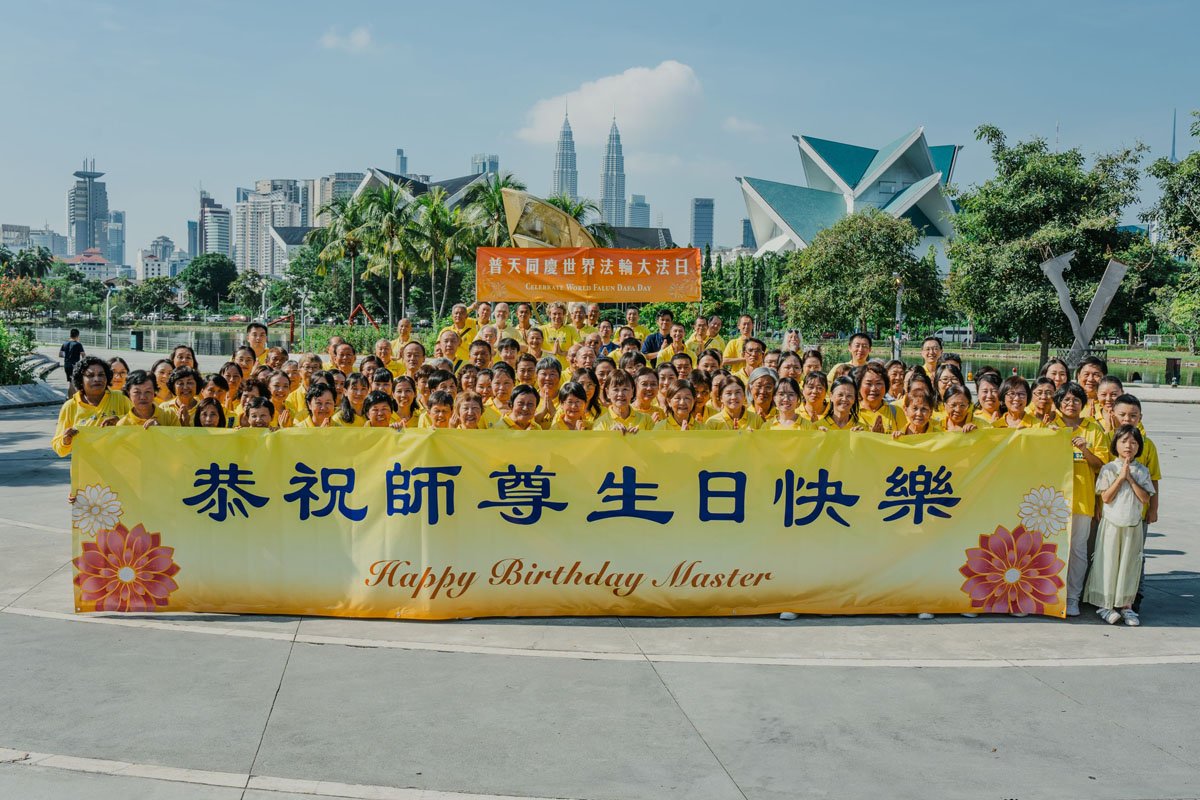
Falun Gong in Malaysia is a legal, freely practised meditation and self-cultivation discipline with group practice sites, Fa study groups and free nine-day introductory workshops across the peninsula and East Malaysia — from Kuala Lumpur and Selangor to Penang, Johor, Melaka, Perak, Negeri Sembilan and Sabah. Malaysian practitioners run outreach in three languages, hold an annual World Falun Dafa Day celebration in May, mark July 20 with rallies and candlelight vigils, and take part in Chinese New Year parades. This guide covers the practice, where to learn it free of charge, what happens at each event, and the human rights issues Malaysian practitioners raise.
Falun Gong in Malaysia at a glance
| Item | Details |
|---|---|
| Also known as | Falun Dafa, 法轮大法, 法轮功 |
| Core principles | Truthfulness, Compassion, Forbearance (Zhen–Shan–Ren) |
| Legal status in Malaysia | Legal; practised openly in public parks and at tourist sites |
| Cost | Free — books, exercise instruction and workshops carry no charge |
| Languages used in outreach | Chinese, Malay (Bahasa Malaysia) and English |
| States with active groups | Kuala Lumpur, Selangor, Penang, Kedah, Johor, Melaka, Perak, Negeri Sembilan, Sabah |
| Key annual events | World Falun Dafa Day (May 13), July 20 rally and candlelight vigil, Chinese New Year parades |
| Introductory format | Nine-day workshop — nine recorded lectures plus the five exercises |
| Local association website | falundafa.org.my |
What is Falun Gong?
Falun Gong, also called Falun Dafa, is a self-cultivation practice rooted in traditional Chinese culture. It pairs five gentle exercises — four standing sets and one seated meditation — with a moral philosophy built on three principles: Truthfulness, Compassion and Forbearance. Mr. Li Hongzhi introduced it publicly in China in 1992, and it spread almost entirely by word of mouth. By the late 1990s, estimates placed the number of people practising in China at around 100 million.
There is no membership, no fee structure, no clergy and no building you must attend. The main text, Zhuan Falun, has been translated into more than 50 languages — including a Malay-language edition — and is available as a free download. Anyone new to the subject may want to start with our overview of what Falun Gong (Falun Dafa) is.
On July 20, 1999, the Chinese Communist Party (CCP) launched a nationwide campaign to eliminate the practice inside China. That campaign is now in its 27th year, and it is why Falun Gong communities in free countries — Malaysia among them — hold commemorative events each July.
How Falun Gong took root in Malaysia
Falun Gong reached Malaysia in the 1990s, spreading first through the Chinese-Malaysian community via books, exercise tapes and word of mouth, and then more widely. Unlike some countries where the community formed largely from post-1999 arrivals, Malaysia’s groups grew organically before the persecution began and have continued to grow since — a distinction that shows in the makeup of local gatherings today, where second-generation Malaysian practitioners sit alongside newer participants and residents originally from mainland China.
The geographic spread is genuinely national. Reports and greetings published over 2025 and 2026 came from practitioner groups in Kuala Lumpur, Petaling Jaya, Selangor, Seremban, Melaka, Johor (including Kulai), Penang, Kedah, Perak and Sabah, plus Fa study groups formed by residents originally from Shandong, Shenzhen and Hohhot in China. Some of these are large; others are two-person study groups meeting in someone’s living room. Both count.
One characteristic of Falun Gong in Malaysia stands out compared with most other countries: outreach happens routinely in three languages. At the July 2026 Johor rally, the opening addresses were read in Chinese, Malay and English — the same trilingual format used at the 2024 Kuala Lumpur rally. In a plural society, that is not a cosmetic detail; it is what allows the practice to be explained to Malay, Chinese and Indian Malaysians alike, and to the international tourists who make up much of the audience at parade events.
Learning Falun Gong in Malaysia: the nine-day workshop
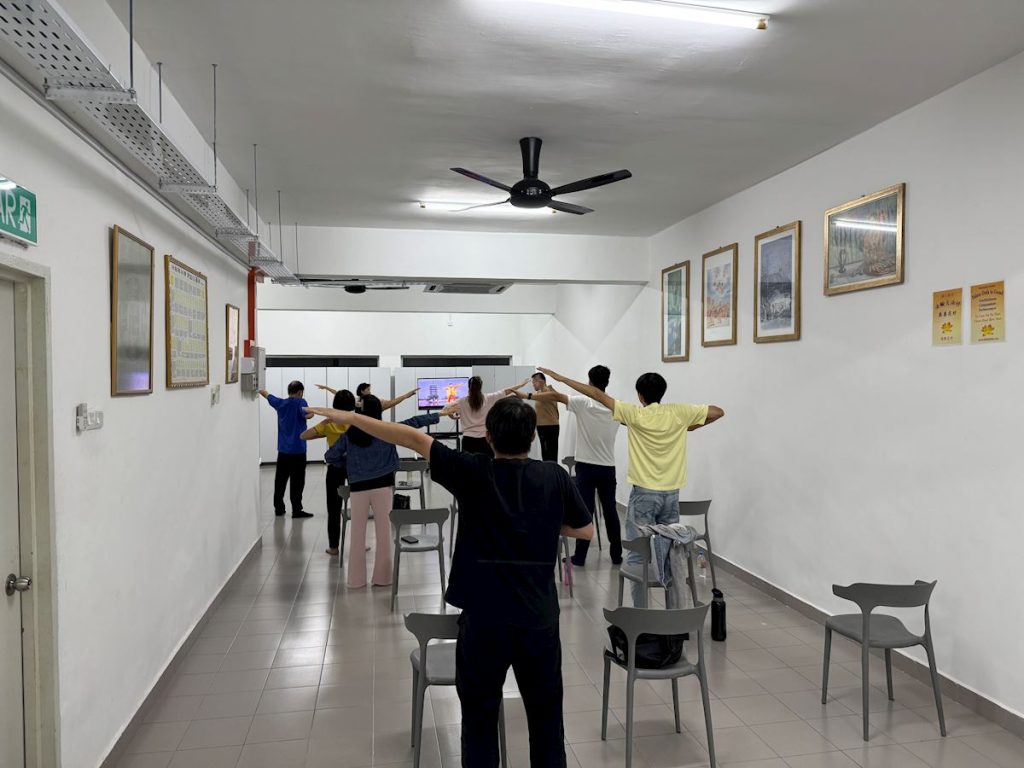
The standard entry point worldwide, and the one Malaysian practitioners use most, is the nine-day workshop. Over nine consecutive days — typically two to three hours per session — attendees watch recorded video of Mr. Li’s nine lectures in sequence and learn all five exercises. It is free, open to the public, and there is no obligation to continue afterwards.
Two recent sessions illustrate the format. Practitioners in southern Malaysia held one in the town of Kulai, Johor, from May 23 to 31, 2026, attended by a mix of longtime practitioners and complete beginners who had heard about it from friends or family. An earlier session ran in the same town from November 29 to December 7, 2025. Sessions are also held periodically in the Klang Valley and other regions.
What attendees report
Minghui’s reporting on the Kulai workshops collected several first-person accounts:
- Ms. Lin first read Zhuan Falun at her sister’s home and was later taken to a group practice site by her brother-in-law. She said a frozen shoulder that had persisted through paid treatment and massage eased without her noticing when it happened, and that pain from a back sprain resolved after she kept doing the exercises.
- Ahua, who attended with his wife, said he felt his body stretch out and relax noticeably after the first exercise.
- Mr. Fu, a returning participant, found that correcting his exercise movements made a distinct difference to how the sets felt, and said the session left him resolved to look inward more consistently.
- Ms. Tang, practising since 2010, described a change she considered more important than any physical one: she and her husband had been close to divorcing, and learning to be more considerate of each other reduced the conflicts. She also said she gave up buying lottery tickets and her insomnia improved.
- Mr. Li, a young engineer at the 2025 session, said his tension disappeared after doing the exercises and that he particularly liked the fourth exercise.
Health note. The accounts above are personal experiences described by the individuals concerned, not clinical evidence. Falun Gong is a spiritual and meditative discipline, not a medical treatment, and nothing here should be read as a claim that it treats, cures or prevents any condition. Anyone with a health problem should stay under the care of a qualified doctor and should not stop or delay prescribed treatment. Research on qigong and meditation more generally points to benefits for stress, sleep and overall wellbeing — a separate matter from what individual testimony describes.
Community life: study groups and experience-sharing conferences
Beyond the public events, the daily substance of Falun Gong in Malaysia is quieter: small groups meeting to read the teachings together and to practise the exercises in a park at dawn.
Rebuilding after the pandemic
COVID-19 disrupted group practice everywhere, and Malaysia was no exception. Elissa, a Kuala Lumpur practitioner who took up the practice in 2014 after being drawn to the exercise music in a park, described how the site in the Seremban area had largely stopped during the pandemic and then lost its coordinator. She set up a new practice site in a park and offered her own home as a study venue. For more than three years she has also brought fellow practitioners to tourist areas to do the exercises and talk to visitors.
A practitioner originally from China described a similar rebuilding effort from the other direction — attendance at his local group study had thinned, so he simply started meeting again at fixed times, on the principle that a session with two people is still a session. Attendance gradually recovered. His conclusion is worth quoting for anyone in a similar position: building the environment is not only the coordinator’s job, and anyone can start a group.
The January 2026 experience-sharing conference
The Malaysia Falun Dafa Cultivation Experience Sharing Conference was held at the Crystal Crown Hotel in Petaling Jaya on January 11, 2026, drawing practitioners from across the country. Twenty-one people presented papers about applying the three principles at home, at work and in outreach projects.
The papers were notably unglamorous, which is rather the point. Zhewei, who grew up in a practising family in Kuala Lumpur, spoke about breaking a long-running video game habit — deleting his games, relapsing, then working out that the underlying pull was competitiveness and the wish to show off, and deleting them again. Mr. Li, a media editor, described setting himself a rule that no matter how late his video editing ran, he would read one lecture of Zhuan Falun before sleeping, and finding that his work output was steadier when he kept to it.
The July 2026 coordinators’ gathering
On July 11–12, 2026, volunteer coordinators from across Malaysia gathered in Kuala Lumpur for two days of reading the teachings together and sharing experiences. Several themes recurred: family relationships, the difficulty of staying consistent, and the responsibility that comes with organising for others.
Ms. Chen, from Sabah, had attended only one comparable event in the previous decade. She described years in which her husband opposed her practice — at one point asking her to take down a portrait in their home — and how his position eventually reversed entirely. She also spoke candidly about a period of more than a year when depression left her unable to keep up her practice, and about deciding to attend the gathering despite her doubts.
Zixin, a young practitioner from Sabah attending her first large gathering, recalled being encouraged as an early teenager to phone people in China to talk about the practice, and being repeatedly scolded. She kept at it, and after about two weeks found that more people were willing to listen.
Mr. Lu, a secondary school teacher from Perak, reflected on how the conduct of someone in a coordinating role affects everyone around them, and concluded that difficulties at work had mainly shown him what he needed to work on in himself.
Public events: the Malaysian calendar
July 20 — rally and candlelight vigil
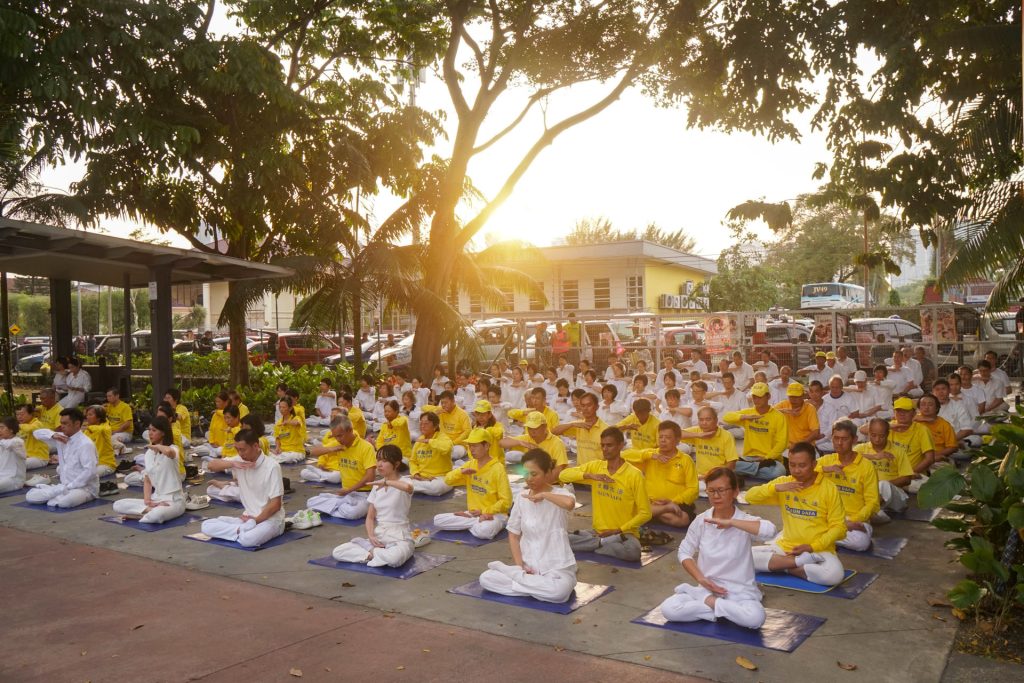
The most significant date is July 20, marking the anniversary of the 1999 ban. In 2026 the main Malaysian event was held on July 5 at Hutan Bandar Putra Kulai in Johor. It opened with trilingual addresses introducing Falun Dafa and condemning the persecution, followed by an exercise demonstration that continued through a spell of drizzle while park visitors stopped to watch.
Practitioners handed out materials and collected signatures on a petition calling for an end to state-sanctioned forced organ harvesting. As night fell, they held a silent vigil with lotus lanterns for those who died in custody in China. Participants ranged in age from 20 to 90; one 87-year-old, Nanhua, stayed through the entire event despite the rain. Yanni, attending her first vigil, said what struck her most was that nobody left early.
The equivalent 2025 event took place on July 20 at Titiwangsa Lake Gardens in Kuala Lumpur, where practitioners in white did the exercises beside the lake from 5 p.m. before a candlelight vigil at 7 p.m. In 2024, practitioners held a rally near the Chinese Embassy in Kuala Lumpur and a separate rally and vigil at Bukit Bintang, with speeches in Chinese, Malay and English and a letter delivered to the embassy.
May — World Falun Dafa Day
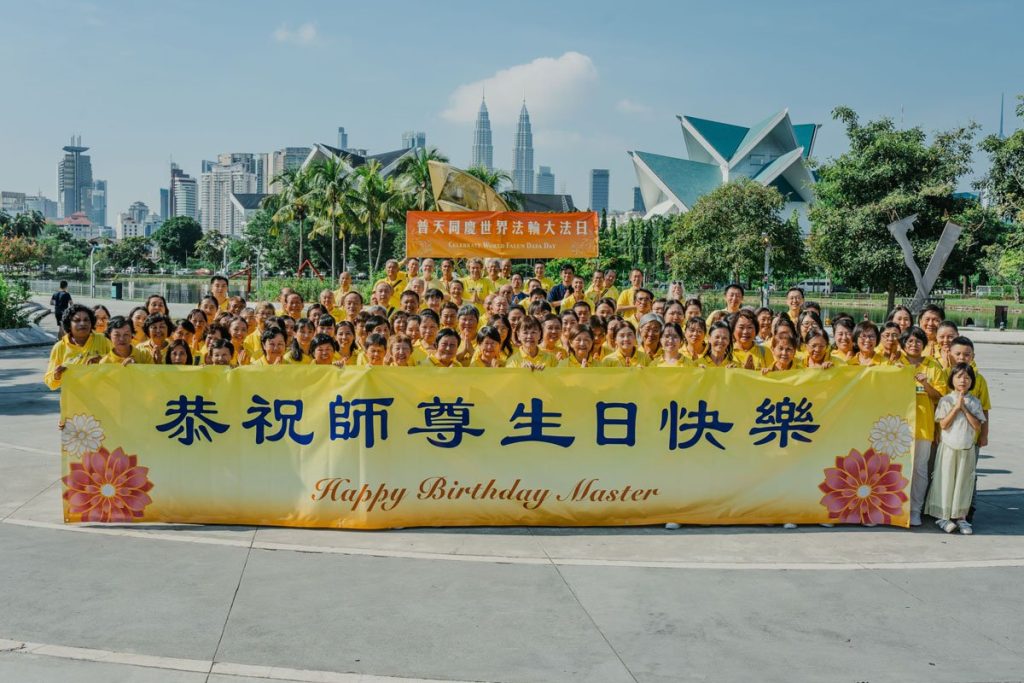
May 13 marks the anniversary of the practice’s public introduction and is celebrated worldwide. In Malaysia the celebrations are decentralised: groups in Melaka, Johor, Kuala Lumpur, Penang and elsewhere hold their own gatherings and send greetings, including from young practitioners’ study groups and from residents originally from mainland China.
A representative example: in 2024, practitioners from Penang and Kedah gathered at Sri Nibong Park on Penang Island on the morning of May 12, demonstrating the exercises to recorded music while passers-by stopped to watch, and handing out introductory brochures.
Chinese New Year parades
This is the most distinctively Malaysian item on the calendar. On February 1, 2025 — the fourth day of the Lunar New Year — practitioners held New Year parades near tourist areas on Pulau Ketam, the island off Port Klang in Selangor, and in Melaka city. The Pulau Ketam parade was the first the community had held there since the 2020 pandemic.
The procession format reads like a Malaysian street festival rather than a demonstration: the Tian Guo Marching Band playing “Falun Dafa is Good” and “Triumph”, followed by a waist drum troupe, a celestial maidens team, a dragon dance troupe and an exercise demonstration team, winding through the town streets. Residents and tourists stopped to watch, took photographs, and exchanged New Year greetings with participants — several remarked on the positive atmosphere.
Human rights: what Malaysian practitioners are raising
Malaysian practitioners are careful to frame their public events as human rights advocacy rather than politics, and the substance supports that framing. Three concerns recur.
The persecution itself. Since July 1999, practitioners inside China have been detained, imprisoned and tortured for their belief. More than 5,000 deaths in custody have been confirmed by name, and the real number is believed to be higher because verifying information from inside China is difficult. Several people who spoke at the 2026 gatherings had direct experience: one Kuala Lumpur resident, originally from China, described her parents being arrested one after the other when she was young, and her own later detention in shackles.
Forced organ harvesting. The allegation that detained practitioners are killed for their organs is the charge Malaysian practitioners put in front of the public most consistently — it is the subject of the petition circulated at the Johor rally, and many passers-by signed. Our separate explainers cover what forced organ harvesting is and the evidence relating to Falun Gong practitioners.
Pressure reaching beyond China. Chinese embassies and consulates have, in many countries, distributed material characterising Falun Gong as a dangerous cult and lobbied venues and officials against Falun Gong–associated events, notably Shen Yun Performing Arts. Malaysian practitioners’ 2024 rally outside the Chinese Embassy in Kuala Lumpur was in part a response to this pattern.
Is Falun Gong a cult? Addressing the common objections
Because the CCP has spent 27 years promoting the “cult” characterisation, it is worth setting out what an observer can actually verify about the practice in Malaysia:
- No money changes hands. Books, exercise instruction, workshops and events are free. There is no tithe, no course fee and no fundraising requirement.
- No membership and no register. There is nothing to join and nothing to leave. People attend a park session or a nine-day workshop and simply stop coming if they wish — several accounts above describe people who lapsed for years and returned.
- No isolation from family. The opposite pattern appears repeatedly in practitioners’ own accounts: workshops attended with spouses, family members who oppose the practice being left to their own view, marriages described as improving.
- No hierarchy with power over people. Coordinators are volunteers who organise events; the Malaysian accounts show them describing their own shortcomings publicly rather than issuing instructions.
- The exercises are public. Anyone can watch a group practise in a park, or watch the instructional videos online, before deciding anything.
None of this obliges anyone to find the philosophy persuasive. But the specific claims usually bundled into the word “cult” — financial extraction, coerced membership, family isolation, secrecy — do not describe what is observable. For a fuller treatment, see our article on common misconceptions about Falun Gong.
How to learn Falun Gong in Malaysia
- Read the book free. Zhuan Falun is available at no cost in English, Chinese and Malay from falundafa.org. Start there if you prefer to understand the philosophy before doing anything physical.
- Watch the exercise videos. All five exercises are demonstrated in full on the official site. There is no fitness prerequisite and the movements are gentle enough for elderly beginners — the Johor vigil had an 87-year-old participant.
- Find a practice site. The Malaysia Falun Dafa Association maintains listings at falundafa.org.my. Group practice happens in public parks, usually in the early morning, and is free to join.
- Look out for a nine-day workshop. These run periodically in Johor, the Klang Valley and other regions. Nine sessions of two to three hours, no charge, no registration commitment.
- If someone asks you for money, it isn’t Falun Dafa. There is no paid instruction anywhere in the world.
Frequently asked questions
Is Falun Gong legal in Malaysia?
Yes. Falun Gong is legal in Malaysia. Practitioners hold public rallies, parades and vigils, run practice sites in public parks, and organise workshops and conferences without restriction. The ban applies only in mainland China.
Where can I find a Falun Gong practice site in Malaysia?
Group practice sites operate in public parks in the Klang Valley, Penang, Johor, Melaka, Seremban and other areas. The Malaysia Falun Dafa Association publishes locations at falundafa.org.my. Sessions are free and open — you can turn up and watch before joining in.
How much does it cost to learn?
Nothing. Books, exercise instruction, the nine-day workshop and all events are free. Falun Dafa has no fees or membership structure anywhere in the world.
Is there a Malay-language version of the teachings?
Yes. Zhuan Falun has been translated into Malay and is available as a free download, alongside Chinese and English editions. Malaysian practitioners routinely conduct public events in all three languages.
Is Falun Gong a religion?
It is generally described as a spiritual self-cultivation practice rather than a religion. There is no clergy, no congregation, no rite of membership and no place of worship. Practitioners read the teachings, do the exercises and try to apply Truthfulness, Compassion and Forbearance in ordinary life.
What is a nine-day workshop?
It is the standard introduction: nine consecutive daily sessions of roughly two to three hours, in which participants watch Mr. Li’s nine recorded lectures in order and learn the five exercises. Malaysian sessions have recently been held in Kulai, Johor. Attendance is free and there is no obligation to continue.
Can Falun Gong improve health?
Many practitioners report better energy, sleep and stress levels, and some describe more striking changes. These are personal accounts rather than clinical findings. Falun Gong is not a medical treatment and does not replace medical care; anyone with a health condition should consult a doctor.
Why do practitioners in Malaysia hold rallies about China?
Because the practice is still banned and suppressed in China, and Malaysian practitioners include people whose families were directly affected. The July events raise awareness of detentions, deaths in custody and forced organ harvesting, and gather petition signatures. They are framed as human rights advocacy rather than party politics.
The bigger picture
What emerges from a year of reporting on Falun Gong in Malaysia is a community that is unspectacular in the best sense. A two-person study group is treated as worth restarting. A teacher from Perak concludes that his workplace troubles were mainly about himself. A woman in Sabah admits publicly that she lost a year to depression and had doubts about even showing up. A dragon dance troupe winds through Pulau Ketam on the fourth day of the New Year and the tourists wave back.
Set against that, the July vigils carry their weight precisely because the rest of the year is so ordinary: the same people who hand out flyers at a park in Johor are asking the public to notice that in another country, doing exactly this would be a criminal act.
This page is updated as new events are reported. For comparable overviews elsewhere in the region, see our guides to Falun Gong in Indonesia, Falun Gong in South Korea and Falun Gong in Australia.
Sources
- Minghui.org — Malaysia: Studying Dafa Teachings Together and Sharing Cultivation Insights (July 20, 2026)
- Minghui.org — Malaysia: Practitioners Raise Awareness of the 27-Year Persecution (July 15, 2026)
- Minghui.org — Nine-Day Falun Gong Class Held in Malaysia Benefits Practitioners (June 10, 2026)
- Minghui.org — Falun Dafa Practitioners in Malaysia Celebrate World Falun Dafa Day (May 14, 2026)
- Minghui.org — Falun Dafa Experience-Sharing Conference Held in Malaysia (January 15, 2026)
- Minghui.org — Candlelight Vigil Marks 26 Years of Peaceful Efforts to End the Persecution (July 26, 2025)
- Minghui.org — Falun Dafa Practitioners in Malaysia Celebrate World Falun Dafa Day (May 16, 2025)
- Minghui.org — Malaysia: New Year Parades Garner Praise for their Positive Energy (February 11, 2025)
- Malaysia Falun Dafa Association — falundafa.org.my (practice site listings)
- Falun Dafa official site — free exercise instruction videos and the Malay edition of Zhuan Falun
Last updated: August 2026.