
Last Updated on 2 months ago by Editor
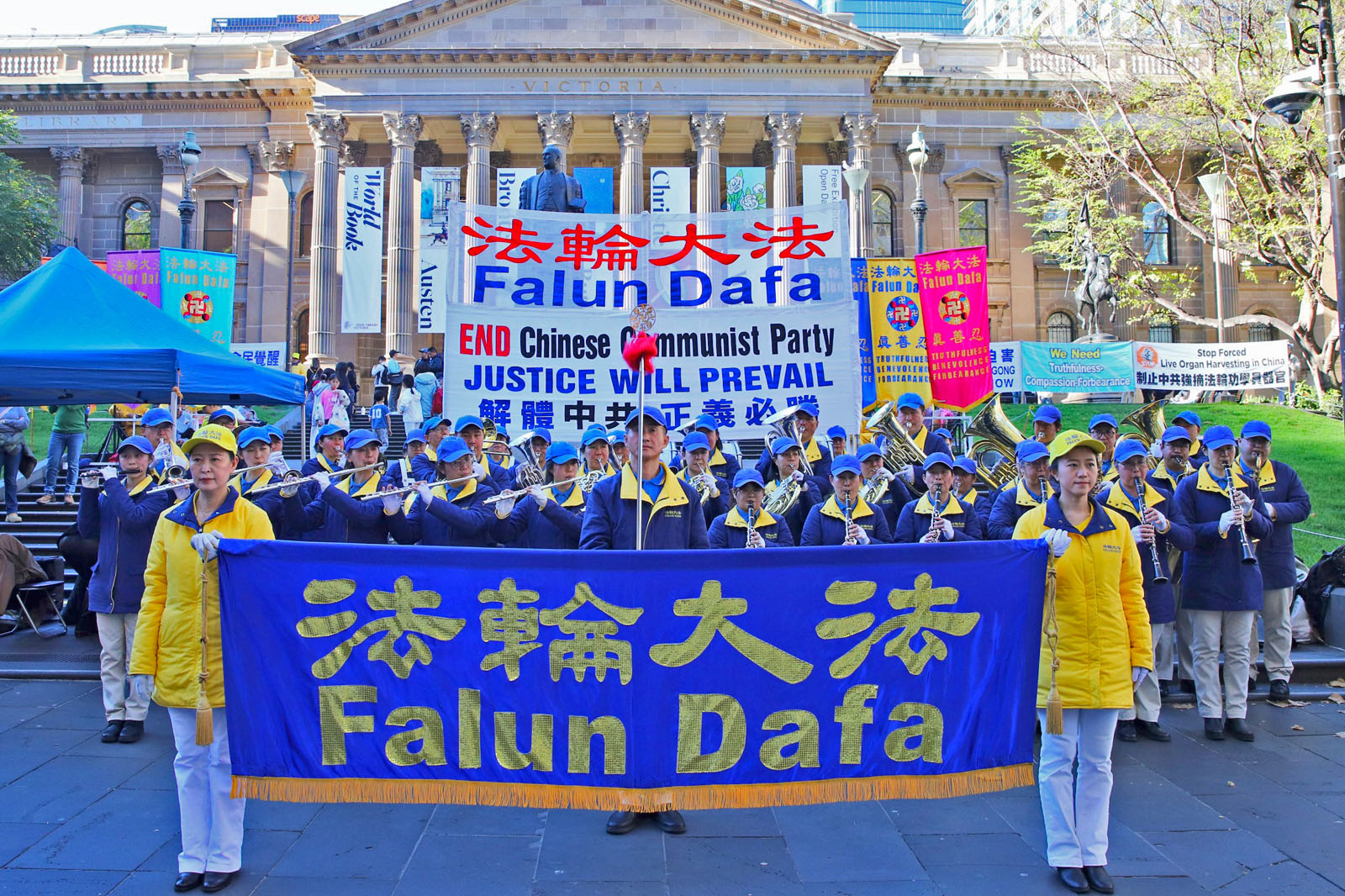
Falun Gong in Australia is a small but highly visible spiritual community that has been practising publicly since the mid-1990s. Also known as Falun Dafa, the discipline combines five gentle meditation exercises with a moral philosophy built on Truthfulness, Compassion and Forbearance (真善忍). Australian practitioners meet free of charge in parks and community centres in every state, and each year they hold parades, rallies and candlelight vigils to draw attention to the Chinese Communist Party’s (CCP) suppression of the practice inside China.
What is Falun Gong?
Falun Gong (Falun Dafa) is a Chinese self-cultivation practice introduced publicly by Mr. Li Hongzhi on 13 May 1992. It consists of four standing exercises and one sitting meditation, together with a body of moral teachings centred on Truthfulness, Compassion and Forbearance. It is always taught free of charge, has no membership and no fees, and is now practised in more than 100 countries.
The main text, Zhuan Falun, has been translated into more than 50 languages and can be downloaded at no cost. For a fuller introduction, see our guide to what Falun Gong is.
History of Falun Gong in Australia
Falun Gong reached Australia in 1995, only three years after it was made public in China. Interest grew after the founder gave lectures in Sydney in 1996 and again in 1999, and small practice groups formed in the capital cities. For the first few years the practice spread quietly, mostly by word of mouth among Chinese-Australian families and their neighbours.
That changed on 20 July 1999, when the CCP under Jiang Zemin launched a nationwide campaign to eradicate the practice. Australian practitioners — many with relatives still in China — began holding public awareness events, and have done so continuously ever since. The Falun Dafa Association of Australia now operates as a registered charity with branches in the states, running free classes, coordinating community events and making submissions to parliamentary inquiries on foreign interference and human rights.
Timeline at a glance
| Year | Milestone |
|---|---|
| 1992 | Falun Dafa introduced publicly in Changchun, China |
| 1995 | Practice first introduced in Australia |
| 1996 & 1999 | Lectures given in Sydney; local practice sites expand |
| 1999 | CCP bans the practice in China on 20 July; Australian awareness campaign begins |
| 2006 | First evidence emerges of forced organ harvesting from detained practitioners |
| 2026 | 27th year of peaceful protest; events held in seven Australian cities |
Where to learn Falun Gong in Australia
All classes and materials are free. Practice sites operate in parks and community halls in most capital cities, and volunteers also run introductory sessions online.
| State / City | Where to find local groups |
|---|---|
| National | learnfalungong.org.au |
| Sydney, NSW | Falun Gong NSW |
| Melbourne, VIC | Falun Gong Victoria |
| Brisbane, QLD | Falun Dafa Queensland |
| Adelaide, SA | Falun Gong South Australia |
| Books & videos | falundafa.org (free download) |
Falun Gong in Australia: 2026 events and news
World Falun Dafa Day celebrations, May 2026
May is the busiest month in the Australian calendar, marking the anniversary of the practice’s public introduction on 13 May.
In Sydney, practitioners did the exercises together at Martin Place on the morning of 7 May before a parade set off down Castlereagh Street towards Belmore Park. Onlookers described the procession as peaceful and were struck by the waist-drum troupe. A second celebration followed outside Sydney Town Hall on 10 May, where the Falun Dafa Association of Australia’s spokesperson John Deller explained that the practice is taught by volunteers at no cost and is open to anyone regardless of background, language or means. (Report)
In Melbourne, an hour-long parade on 9 May ran from Queen Victoria Gardens through Chinatown to the State Library of Victoria. Victorian MP David Limbrick addressed the closing rally, saying he attended in support of freedom of belief, speech and assembly, and praising the restraint practitioners have shown over decades of peaceful protest. (Report)
Further rallies were held at Box Hill shopping centre on 16 May and Dandenong Palm Plaza on 23 May. Whitehorse City Councillor Blair Barker, who has joined the morning exercises in Box Hill Gardens himself, told the crowd that Truthfulness, Compassion and Forbearance are deeply Australian values
. (Report)
Community festivals: Blacktown and Springvale
On 30 May 2026 practitioners joined Streets Alive and Parade Day, Blacktown’s largest annual festival, with a stage exercise demonstration, waist-drum performance and dance items. Several visitors said the atmosphere at the stall was what drew them in, and asked where they could start learning. (Report)
Three weeks later, on 21 June, a booth at the Springvale Winter Fest in south-east Melbourne combined exercise demonstrations with origami activities for children. A local business owner said the moral principles function as pillars for daily life and workplace conduct; a pharmacy manager said she had been looking for exactly this kind of practice; and a Year 12 student singled out forbearance as the quality she most wanted to develop. (Report)
The Art of Zhen Shan Ren exhibition in Sydney
From 25 June to 7 July 2026, the international Art of Zhen Shan Ren exhibition was shown at M2 Gallery in Sydney, part of a touring programme that has visited more than 300 cities in over 50 countries since 2005. The paintings are all by practitioners, several of whom were imprisoned in China, and alternate between scenes of serenity and depictions of custodial abuse. Sydney visitors left guestbook notes describing the works as calming and informative. The same body of work was shown in Landsberg, Germany, and San Diego, USA, during the same period. (Report)
July 2026: 27 years of peaceful protest
Every July, Australian practitioners mark the anniversary of the 1999 ban. In 2026 events ran across seven cities.
| City | Date | Event |
|---|---|---|
| Perth | 12 July | Protest outside the Chinese Consulate, East Perth |
| Sydney | 16–17 July | Martin Place rally with the Tian Guo Marching Band; candlelight vigil at Town Hall |
| Adelaide | 17 July | Rally at South Australian Parliament House |
| Brisbane | 18 July | March through the CBD and rally at Brisbane Square |
| Melbourne | 18 July | Rally at the State Library of Victoria |
| Adelaide | 20 July | Candlelight vigil, Victoria Square |
| Canberra | 20 July | Candlelight vigil at the Chinese Embassy |
| Sydney & Melbourne | 20 July | Exercises and vigils outside the Chinese Consulates |
At the Canberra vigil, a representative cited Minghui’s verified figure of 5,359 practitioners confirmed to have died as a result of the persecution, with many more still unaccounted for. A 26-year-old who came to Australia from China described a childhood spent moving between relatives’ homes and being detained and questioned at a police station as a minor. (Report)
In Brisbane, the march was organised into sections covering the benefits of the practice, the suppression campaign, and remembrance of those who died. Queensland Federation of Taiwanese Associations sent a letter of support, and Queensland Senator Malcolm Roberts wrote that We stand firmly in support of Falun Dafa
. Passersby included an engineer visiting from India who joined the procession, and Chinese residents who chose to renounce their CCP affiliations on the spot. (Report)
Political and community support
Support for Falun Gong in Australia is notably cross-partisan and cross-community. Speakers at the 2026 events included:
- Prof. David Flint AM — jurist and former chair of the Australian Broadcasting Authority. He urged the Australian Parliament to legislate against transplant tourism to China, referencing the London-based China Tribunal’s finding that tens of thousands of people have been killed for their organs.
- Prof. Yuan Hongbin — Chinese-Australian legal scholar, who described the campaign as the gravest human rights disaster of the 21st century.
- Prof. Feng Chongyi — human rights researcher, who argued that the practice was targeted not for wrongdoing but because an authoritarian system cannot tolerate independent belief.
- Tammy Franks and David Paton — South Australian parliamentarians, who condemned both the persecution and the CCP’s reach into Australia.
- Craig Kelly — former federal MP, who recalled encountering CCP anti-Falun Gong propaganda in a Shenzhen hotel some 25 years ago.
- Bahtiyar Bora — President of the Australian Uyghur Association, who framed the issue as one of solidarity between persecuted communities.
- Kapsang Tsering (Tibetan Community in Victoria) and Duy Quang Nguyen (Vietnamese Community in Australia, Victoria) — both spoke at the Melbourne rally in support. (Report)
- Sophie York — barrister, whose letter was read at the Sydney rally, drawing a parallel with the sudden collapse of Eastern European communist regimes.
Transnational repression: a growing concern in 2026
A recurring theme across the 2026 Australian events was the extension of the campaign beyond China’s borders. The Falun Dafa Association in Victoria pointed to the CCP’s United Front Work Department, consular networks and online influence operations, and warned that pressure has escalated sharply.
Speakers highlighted China’s Ethnic Unity and Progress Promotion Law, introduced on 1 July 2026, arguing that it is drafted broadly enough to reach individuals and organisations outside China and to criminalise speech on foreign soil. Former South Australian MP Tammy Franks separately condemned bomb threats directed at the Australian Prime Minister over Shen Yun Performing Arts, describing such intimidation as fundamentally incompatible with Australian norms. Practitioners have called on the federal government to condemn the campaign publicly and to strengthen protections against foreign interference.
Why is Falun Gong persecuted in China?
By 1999 official Chinese estimates put the number of practitioners at 70–100 million — more than the CCP’s own membership. Perceiving an independent group of that size as a threat to its ideological monopoly, Jiang Zemin ordered the practice banned on 20 July 1999. Practitioners have since been subjected to arbitrary detention, forced labour, coercive “transformation” programmes and torture. Since 2006, investigators have documented the forced harvesting of organs from detained prisoners of conscience.
Minghui.org has verified 5,359 deaths resulting from the persecution as of July 2026, a figure widely regarded as a significant undercount given the difficulty of gathering information inside China. For background on the transplant issue, see our analysis of the organ harvesting supply chain.
Frequently asked questions
Is Falun Gong legal in Australia?
Yes. Falun Gong is entirely legal in Australia. Practitioners meet in public parks, hold registered public assemblies, and the Falun Dafa Association of Australia is a registered charity. The practice is banned only in mainland China.
How many people practise Falun Gong in Australia?
No official census figure exists, as the practice has no formal membership. Active practice sites operate in all major cities, and events such as the Sydney and Melbourne parades typically draw several hundred participants.
Does it cost anything to learn Falun Gong in Australia?
No. All instruction is provided free by volunteers, and the books and exercise videos are available as free downloads. There are no fees, membership dues or donations required.
Is Falun Gong a religion?
It is generally described as a spiritual or self-cultivation practice rather than an organised religion. There is no clergy, no places of worship, no congregational membership and no ceremonies of initiation.
When is World Falun Dafa Day?
13 May each year, marking the date the practice was first taught publicly in 1992. Australian celebrations are usually held on the weekend nearest that date.
Where can I see Falun Gong events in Australia?
Major public events cluster around mid-May (World Falun Dafa Day) and mid-to-late July (the anniversary of the 1999 ban), typically in the CBDs of Sydney, Melbourne, Brisbane, Adelaide, Perth and Canberra.
Further reading
- What is Falun Gong (Falun Dafa)?
- Falun Gong in Indonesia
- Falun Gong in South Korea
- Shen Yun Performing Arts
This page tracking Falun Gong in Australia is updated as new activities, rallies and community events are reported. Last updated: August 2026.