
Last Updated on 4 months ago by Editor
Quick answer: The best meditation sitting position is the one you can hold comfortably with a straight, relaxed spine. Beginners do well starting in a chair or the Burmese position, then progressing toward quarter, half, and full lotus only as their flexibility allows. You do not need to sit in lotus to meditate.
Comparison table: which sitting position is right for you?
| Position | Difficulty | Stability | Best for |
|---|---|---|---|
| Chair sitting | Very easy | Moderate | Complete beginners, limited mobility, back issues |
| Burmese | Easy | Good | Beginners sitting on the floor |
| Quarter lotus | Easy–moderate | Good | Building toward cross-legged sitting |
| Half lotus | Moderate | Very good | Intermediate practitioners with flexible hips |
| Full lotus | Difficult | Excellent | Experienced, flexible practitioners |
Below, each position is explained from easiest to most advanced. There is no “best” posture that suits everyone — the right choice depends on your flexibility, comfort, and goals.
Chair sitting (start here if unsure)
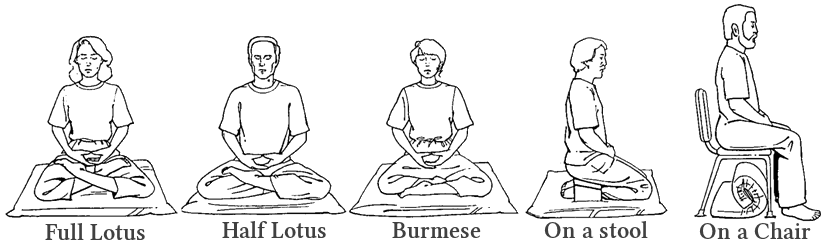
Sitting in a chair is the most accessible posture and a perfectly legitimate way to meditate. Sit toward the front of the seat, place both feet flat on the floor, and keep your spine upright without leaning back. Rest your hands on your thighs. It is ideal for beginners, anyone with knee or back limitations, and longer sessions where floor sitting becomes uncomfortable.
Burmese position
In the Burmese position, both legs rest flat on the floor in front of you, with one lower leg placed ahead of the other — neither foot is lifted onto a thigh. It is the gentlest floor posture and a great first step away from a chair. Sitting on a firm cushion that lifts your hips above your knees makes it noticeably more comfortable.
Quarter lotus
Quarter lotus is a small step up: you sit cross-legged with one foot resting on the calf of the opposite leg, rather than on the floor or the thigh. It adds stability without demanding much hip flexibility, making it a natural bridge between Burmese and half lotus.
Half lotus
In half lotus, one foot is placed on top of the opposite thigh while the other foot stays tucked beneath. It creates a stable, symmetrical base and is a common choice for intermediate practitioners. Remember to alternate which foot is on top across sessions so you do not always load the same hip.
Full lotus
Full lotus places each foot on the opposite thigh, forming the most stable and symmetrical seated posture. It requires considerable hip and knee flexibility and should not be forced. Many traditional seated disciplines — including the tranquil sitting meditation in the Falun Dafa exercises — regard full lotus as the ideal posture to grow into gradually rather than a starting requirement.
How to progress toward full lotus safely
Flexibility for cross-legged sitting comes mainly from the hips, not the knees. Progress slowly and never push through sharp knee pain:
- Spend several weeks comfortable in one position before advancing to the next.
- Do gentle hip-opening stretches outside of meditation, warming up first.
- Always use a cushion to raise the hips above the knees.
- If a posture causes pain — especially in the knees — back off and consult a qualified instructor or physiotherapist before continuing.
If your legs tend to go numb while sitting, our guide on why your legs fall asleep during meditation covers practical fixes.
Frequently asked questions
Do I have to sit in lotus to meditate?
No. Lotus is traditional and very stable, but it is not required. Chair sitting and the Burmese position are completely valid, and what matters most is an upright, relaxed spine you can maintain without strain.
Is full lotus bad for your knees?
Full lotus is safe for people with sufficient hip flexibility, but forcing it can stress the knees. The rotation should come from the hips. If you feel knee pain, stop and choose an easier position; never twist the knee joint to “make” the posture work.
Which position is best for long meditation sessions?
For stability over long sits, half and full lotus are excellent once you have the flexibility for them. Until then, a chair or the Burmese position lets you sit longer in comfort, which matters far more than the prestige of any particular posture.
New to meditation? See our complete step-by-step guide to meditation for beginners, and learn how long you should meditate as you settle into your chosen posture.
This article is for informational purposes only and is not a substitute for professional medical advice. If you have knee, hip, or back problems, consult a qualified healthcare provider before attempting cross-legged sitting positions.